Posts

Who am I to come into this person’s home with demands and unrealistic expectations?

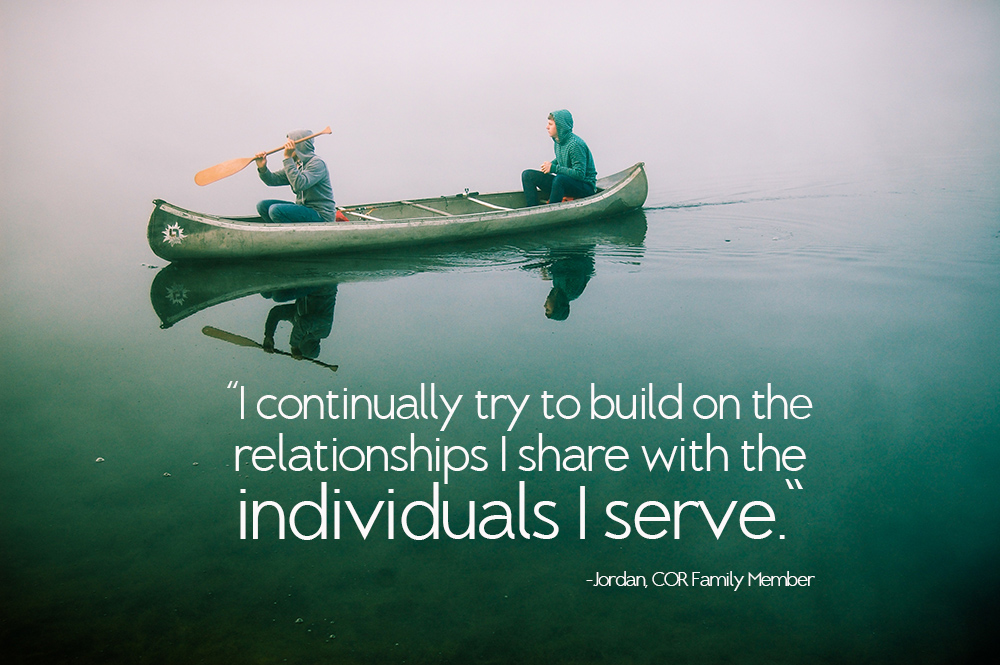
I consistently strive to build and maintain a culture of gentleness among the individuals I support and spend time with. When I am in someone’s home I try to put myself in their shoes. Who am I to come into this person’s home with demands and unrealistic expectations? Trying to be mindful of what I say/how I say it and how I present myself to the person receiving support is always at the forefront of my thoughts. By using the four tools (presence, eyes, hands, and words) positively, I continually try to build on the relationships I share with the individuals I serve.

I continually try to build on the relationships I share with the individuals I serve

Ensuring that person feels safe where they are and who they’re with is an important first step. Afterwards is the point at which the person can begin to be stretched and grow. Remembering that the relationship I have with the person I’m supporting is one of interdependence, allows me to teach as well as learn. This is an attitude that I attempt to maintain both within COR with the individuals being supported as well as in my other social circles.


Jordan, COR Support


Onward and Upwards…

In everyone’s life there are those moments or experiences that capture your full attention and enchant your heart. In my life I have had a handful of these experiences: including lying in a rain storm emotionally broken to which when the rain stopped craziest Northern lights began dancing across the skies, my first date with Larissa my beautiful wife and the days that both my children were born.  If you took the time, sat back and reflected on your life I too believe that you would pinpoint experiences that spurred a major reaction within you which kick-started a wave of changes: either big or small. As I sit in this opened aired mall, with people hustling and bustling around with only two weeks before Christmas, I confidently can say that Creative Options Regina (COR) has been added to my life experiences that have provoked change.

Nearly three years ago I took a position with Creative Options Regina after a friend and fellow wait-staff told me about her new position with “this super awesome organization!” The words that flowed from her mouth were captivating and got me excited! Not wanting to sound like a stalked, I hesitantly approached her and asked if she would be ok if I applied with this new-found organization. With a resounding  “YES!” I applied. in the following months, I quit my job as a waiter and engaged in full time support hours with COR. I don’t know if I ever really thanked this person allowed: so now is the time! Thank-you Brittany Bechard for your wisdom in knowing a little about my heart, ‘seeing something in me,’ and  encouraging me to apply. You are an incredible woman and those who you serve and support have a better quality of life because of you. When I first started supporting with COR I served Jesse, Jasen and Shaun. These men are incredible and taught me a lot about myself. Jesse’s determination to do everything in a day, Jasen’s love of authentic relationship and Shaun’s ability to be the slowest eater in the world taught me to embrace the small things, laugh, and rest in the fact that in those moments together nothing else needed to consume me: we were, and that was more than enough. A few short months after starting my journey with COR I was asked if I would consider moving teams to support a young man named Michael. Little did I know that this man would reveal my true colors, challenge me to be a better me, and become not only a friend but a brother.

1380572_10152431665578101_1302041544646813248_n10262049_10152202369193101_8825968592774033917_n10410717_10152466315203101_8085703654700611359_n

My journey with this man was not always easy. Sometimes it was hard. Perhaps it is just me, but I think it is the hard things in life that are worth fighting for. My journey with Michael led me to new heights, literally. In the summer of 2014 we were able to strike out on new adventures together, including a handful of roads trips and an airplane ride around the Regina city limits. Michael, and others in COR have become an intricate part of our family: coming over for meals, playing with our kids and engaging in this “thing” we call life. My words can’t express the joy and appreciation I have for each of the people who have come into my life during this time of my life.

10559809_10152382915853101_6438454310541075323_n

250277_10152574840868101_3030308607101654052_n

10590549_10152384736463101_4252474471381092863_n  1912451_10152801791528101_7228477045715026966_n  12047178_10153416605163101_3018268801905407118_n

Though the people that I have been led to serve have impacted me tremendously: I have been equally left effected by those who I am blessed to call friends and coworkers. From the leadership of the management team, to the bravery of team leaders, to the humility of support people, you have sparked change in my life: Whether it is Jenna walking into my office to “just talk about life”, or going out for a drink with Ryan, Reid, Murray or Bart to talk about the philosophical structures of Gentle Teaching, I have been challenged and changed: Thank-you.

Perhaps this is why it is so difficult to write this blog: the relationships we have built matter! It is with a mixing pot of emotions that I write to tell you that as a family we have decided to resign from my position as Director of Culture and Mentorship and relocate. Our decision was one that was not taken lightly, or easily made. Every square inch of the effect of our decision was scrutinized and processed: to the point of believing that I needed a heart transplant.  It is with great sadness that we let everyone know that as of January 15th, 2016 we will no longer be serving at Creative Options Regina. This decision had little to do with COR and more with my own physical health, the health of our family and an opportunity that we believe will lead us to help spark change elsewhere in Saskatchewan.

As we prepare to leave there are a lot of details that we are hoping and praying will fall into place. But I am fighting hard to finish well. I believe that whatever my hand finds to do I have a role and a responsibility in helping it come to fruition: to pursue the best outcome possible. In the coming weeks, I will be focusing a lot of my time to the curriculum that I have been developing over the past year, along with finding moments to say those proper goodbyes.

If I may: and I will! I would like to leave you with a message of encouragement. It has often been said that Gentle Teaching carries a lot of power. While I don’t disagree with this completely, I believe that it can be refined all the more. Gentle Teaching equips people with the skills and tools to have a voice of influence, which in return equips you with a “power”. Now don’t misunderstand me: I am not suggesting that you are to have power OVER someone. Rather, you, yes YOU, have the ability to be a powerful influence. The way in which you choose to interact with someone, and the words that you use can and will change a person’s life. So I beg you: be kind, speak with wisdom, pursue good, love the lonely, hurting and brokenhearted, know that your purpose on this earth goes beyond the material things that we we can collect for ourselves. The relationships in which you currently find yourself (whether long-lasting or temporary) are the most meaningful. As you go through out your daily life, with friends, loved ones and team members, remember your tools. Your mouth is to speak kind words, uplifting others. When your hand is forced to address difficult situations remember that your words carry a powerful punch and even in the midst of addressing conflict or correction can become vessels of empowerment for those you are speaking to. Your hands are to be agents of care: assisting the homeless, uplifting the broken, encouraging the fearful yet doing all of this together. Your presence should display the message of your intent: I am here with you, through thick and thin. As I often have said my training’s, “we are in this together, because WE, well we are the dream team and nothing can stop us!” And finally use your eyes to empathize, sympathize and see the true story of peoples lives.  Our eyes should not just be used for the present, but be used for the future. Dream big dreams for both yourself and the person you are serving. Work hard not to become entrapped in what you see now, but dream about tomorrow. The people you serve deserve it, and so do you!

From my family to you: we thank-you for the impact that you have had in our lives.

With all of my heart and deepest gratitude,

Ben Raine


The Al McGuire Award Winner for Transition to Employment 2015 – Patrick Flaman

Creative Options Regina (COR) is very happy to annouce that our very own Patrick Flaman is the winner of the Al McGuire Award for Transition to Employment 2015. His work ethic and attitude are like no one else, Patrick is an exemplary employee and just an all around great guy. We’re proud to have Patrick a part of the COR family.

Patrick Flaman-Al mcguire Award winner

“Freedom”: Patrick’s Story

I was living in an approved home before COR. I had a friend that lived in COR and I started hanging out with him more and more. I stayed for sleepovers and his friends got to know me a little bit. He wanted me to move to COR… I guess he suggested it to somebody!

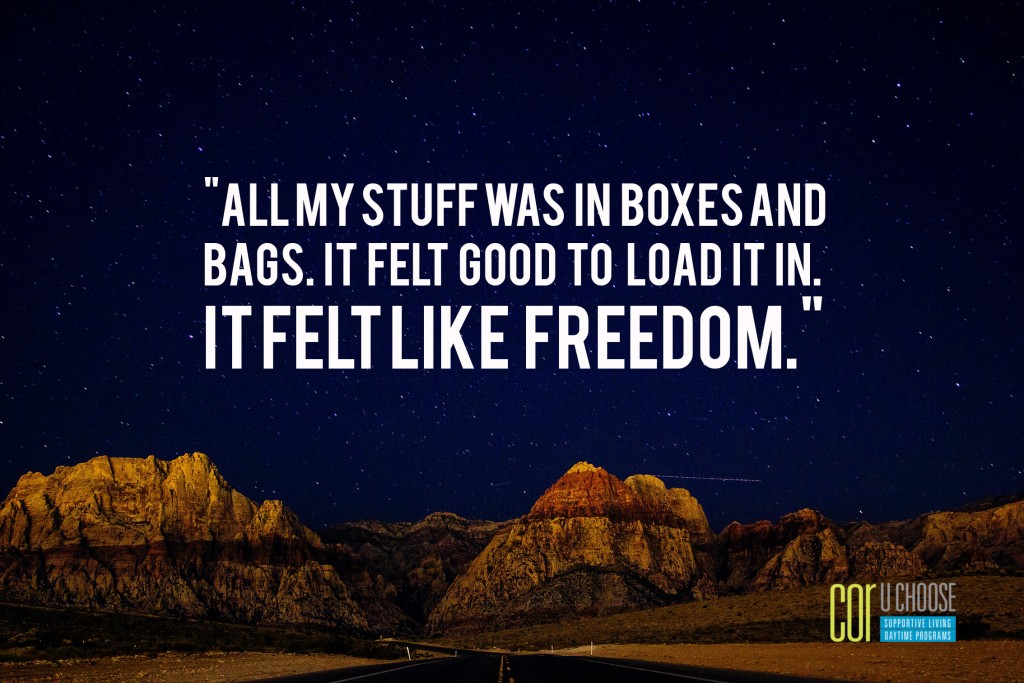
All my stuff was in boxes and bags It felt good to load it in. It felt like freedom

We had some meetings and then Andrew and Jim showed up one day with a U-Haul truck. All my stuff was in boxes and bags. It felt good to load it in. It felt like freedom. I threw everything in there. I came to the house, unpacked the U-Haul and there were lots of people helping me out. I didn’t sleep that night. It was a new environment for me and it took me a while to fall asleep the first couple of nights. Once I felt more comfortable it started to feel like home. I had things given to me for my apartment. On my birthday I was given things that I basically wanted. It was sort of weird at first. I had birthday parties before, but I never got things that I needed. My friends all bought me a Keurig for Christmas this year!

I’m going to a class that helps me deal with my anger, my anxiety, stuff like that. Some days I don’t really feel the greatest… and some days it could be like… I don’t know its kind of an up & down thing for me. Some days are tougher than others. That’s why I’m going to a class. I know that people in COR aren’t judging me or anything and that they are there to listen not scold you. They are there to help, they don’t say “wow that’s a dumb question to ask”, they just listen and try to help. When I moved in I needed somebody to talk to and I had a friend who would sit and listen, help me out and talk with me. It made me feel more comfortable because I know there is always someone to talk to if I need to. I get to go places like the bar, camping trips, hanging out with my friends. There’s not really a curfew. Your friends treat you like an adult, and if there’s a problem we sort of talk it out and work through it.

My friends helped me find a job. I work at Sasktel right on 1st Avenue and Broad Street, not too far from the COR office. I do lots of different things. I sometimes work in the warehouse, I clean 2701’s and 3801’s, just different modems. I sometimes clean ONT’s. It feels good to have a job. I’m not isolating myself because now I actually have a job where I’m responsible for getting up and getting to work on time. I was sort of nervous when I started. I was nervous to ask questions on my first day, but when I got more comfortable I sort of came out of my shell. When I’m on my own I have a thing called Facetime. My friends Facebook, Facetime, text me to make sure I’m okay and stuff like that.

I really like hanging out with people from COR. Going to BBQ’s, hanging out, playing football, just hanging out. There’s one thing that I have learned from that. I don’t look at their disabilities, I look at them as a person. I go to the dances and I have a friend that has MS, but I don’t look at her as MS. I just look at her as just one of my friends I can hang out with and laugh, do stuff with.

What is cor to you?

[What is COR all about?]

People caring about other people, people who are willing to listen, talk to you and make sure you’re alright. They are basically there for caring. COR has a website with lots of videos. Everyone is welcome here and everyone is equal. You should check it out. COR is an awesome place to live.


– Patrick

Common Situations: Refusal to Participate

Common Situations: Refusal to Participate

If the person refuses to participate,

• Make sure there is a structured flow to the day, not just the emptiness of custodial care.
• Be aware of other caregivers who might be coaxing, cajoling, or bribing the person to participate.
• Bring about minimal participation by doing activities with the person.
• Continue to dialogue.
• Emphasize valuing and elicit it during any movement toward the slightest participation.

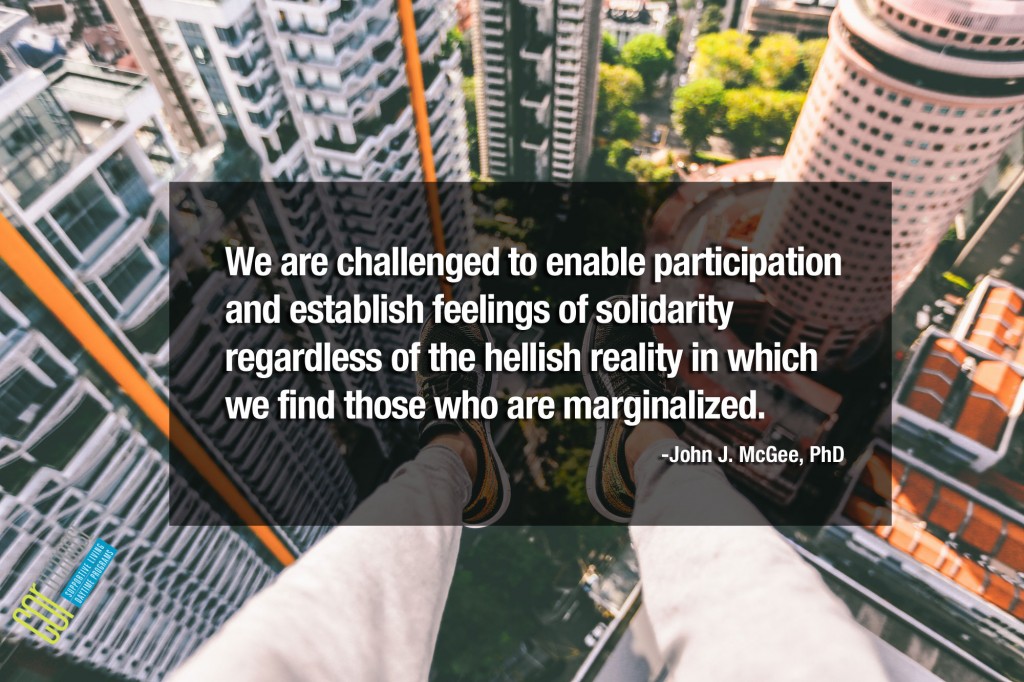
We are challenged to enable participation and establish feelings of solidarity

The major challenge in this situation is to make valuing occur, even in settings that contradict it. Many caregivers work in almost hopeless situations: institutions where the mentally ill are herded like animals, nursing homes where the aged are left to fade away, homeless shelters where the poor are warehoused for an evening. Although we need to fight for social justice and establish decent places for people to live, work and play, many caregivers still need to create hope and feelings of companionship where there is none. Thus, if we work alone in a setting that seems to be the antithesis of valuing and engagement, we have a special and difficult role: to bring hope where only despair reigns.

To bring hope where only despair reigns


We will often be ridiculed for our idealism and seeming naiveté. Yet we can express valuing and create feelings of companionship even in the midst of hopelessness. Our interactions are what matters. If the person in the most forsaken institutional ward runs from us and falls to the floor, we can keep on teaching the meaning of human engagement. If the person lashes out, spits, or screams at us, we can move toward him or her and continue to bring about engagement and give unconditional valuing. We are challenged to enable participation and establish feelings of solidarity regardless of the hellish reality in which we find those who are marginalized.

-John J. McGee, PhD

What is Community?

What is Community? from Creative Options Regina (COR) on Vimeo.

We need to rethink how we define “community”. People will say things like, “lets go out into the community”, when in fact we’re already IN community. We all make up the community; just being you makes you a part of it! Embrace what’s around you!

“Be A Superhero”

IN PRODUCTION–I’ve often wondered why are stories about superheroes so appealing? And why have they always been appealing throughout humankind’s history? (Recall the Roman and Greek gods and goddesses, and countless other myths of people with superhuman strength and power from all cultures throughout the world from all time.) If I was to give a less than educated guess as to their appeal, I would say that they touch something in us that we all long for…perhaps something missing from our very selves.

The reason I think this is because it seems too trite and easy to say that the appeal lies only in the fantastical. As if to say, just because those stories tell us of something that we do not see in real life they keep our attention. I can imagine a story with many fantastical details that would not make me rush to see the movie or buy the book. That is to say, fantastical does not always equal appealing.

So perhaps superheroes’ appeal lies in the fact that they are marked as special, set apart, different, but in a good way–a way that increases their human potential. I believe that is a better explanation of their universal appeal. I believe it appeals to us because we very rarely experience it ourselves.

If this lack is a common existential experience, what does that tell us about our ontological make-up? Why would we all universally experience the same lack or same desire? Were we meant for something greater? Did we, as a race, have a potential that we lost? Or do we intrinsically have it but lost our ability to see it clearly? Why the common yearning and desire?

And then, why do we feel a lack that we seemingly lack the ability to fill? Even recognizing that one desires to be “more” does not enable one to meet their own desire. Even the richest and most powerful people in the world often report that they feel this same lack in life, like something is still missing.

Perhaps finding out what really quenches that desire or fills that lack is the meaning of life.

What-are-you-fighting-for

1) Decide what you want to accomplish

Is there a specific task/dream that you want to accomplish for someone or with someone?

2) Pick a theme song

Don’t take yourself too seriously! Let loose and have fun

3) Decide what you stand for

What are you fighting for?


Process of Stretching

“We teach “safe” by placing almost no demands on the person except for being with the person with a sense of just “being.” It is a tremendously important for one human being to teach another it is good to be near you. Nothing more, nothing less. This act of recognizing the brokenhearted person’s existence and goodness is a most powerful teaching-learning experience. At the same time, we need to engage in nurturing and finding relevant ways to express unconditional love without pressuring the person at all. This might seem weird, but the person will learn to feel safe if we lower our demands while increasing our goodness, kindness, and expression of love. We need to avoid putting the horse before the cart. Doing things is not the primary purpose of care giving; being with one another is.

A dimension that is often hard to understand and deal with involves the emergence of self-centeredness, becoming spoiled, after a time of intense nurturing. It is natural to become self-centered as a result of constant nurturing. This creates another important care giving role. We need to slowly begin to focus on stretching the person away from self-centeredness and toward other-centeredness. This stretching process involves reminding the person that he/she is safe and loved while asking a slight degree more—waiting a moment, taking turns, sharing, and other virtues involving others and our relationships. This process is very delicate so we need to keep reminding the person of how safe and loved he/she is.

The developmental model outlined below is a good guide for us to use to understand the various dimensions of new memories that have to be taught:

• From brokenhearted and lonely, to safe and loved;
• From self-centeredness, to reaching out to others and loving expressing love to them; and,
• From dependence on us, to engagement with us and others.

Doing-things-is-not-the-primary-purpose-of-care-giving-being-with-one-another-is

Our pedagogical process starts with us encountering a brokenhearted person and bringing two simple gifts that we have repeatedly mentioned—the feeling of being safe and loved. We have nothing else to give. These are not a program, a clinical approach, or focused on outcomes. They can, if necessary, be translated into mundane outcomes, but, for the caregiver, they are gifts and these now established feelings need to begin to include being safe with a growing circle of others and becoming a meaningful part of increasing engagement.

This stretching process is a part of normal development. These include learning other moral milestones such as learning to share, a giving up, momentarily, of what is theirs; learning to wait and to take turns; wanting others to feel proud; and, learning when enough is enough—self-control. We all have to learn these milestones. Each requires a grounded stance that assumes that the brokenhearted person has learned to feel safe and loved and is ready for participation in a broader community. After these have been formed in the person’s moral memory, we can then begin focusing on strengthening self-esteem, learning that “I am good!” and self-control, learning when enough is enough!” The person’s world and responsibilities begin to expand.

After an intense dimension involved almost solely with unconditional love, it is natural to enter a phase of self-centeredness. It is then that our role evolves into carefully and delicately stretching the still fragile brokenhearted person from a state of self-centeredness to one of other-centeredness. It is a process in which the person learns that it is good to be with a small circle of others, then it is good to do things with this group, and eventually it is good to do things with a wider circle of friends, and finally it is good to do things for others. This last encompasses a high form of moral maturity.

We also begin to focus on the person’s self-esteem. This milestone emerges when others keep reminding the person, “You are so good!” This begins to occur from the very start when we are teaching that it is good to be together. What happens in this process is that the person begins to feel safe and loved from within. As this occurs, the person begins to see him/herself in a different light and forms a moral memory that says, “I am somebody because my caregivers tell me I am.” As the circle of friends grows, the person’s sense of self-worth also expands and becomes stronger.”

– John J. McGee, PhD

The Caring Moment

In the beginning we must always be in the moment with two bits of knowledge focused on giving a feeling of being safe and loved. We should avoid lengthy case histories and cleanly typed plans. If need be, do these requirements. However, our task is to be in the moment; it is not to change anyone’s behavior, but to teach the person to feel safe with us and loved by us.

The present is a series of moments that tumble into the future. Yet, we should not worry about the future, only the present moment. The here-and-now becomes the future with each ticking second. Our encounters transpire in the moment and then transform the next moment.

The-joy-is-in-the-moments

Whether a mother, father, grandparent, or a person whom we are supporting, the most important variable is the moment, not the future, not a projected plan with outcomes, not behavioral change. No, it is our being present in this very moment and all the person sees, hears, touches, and feels in this mutual coming together. It is the tiniest amount of time, perhaps two or three seconds. Then, these moments are linked together with other moments and it is these moments that become new moments; it is the evolving chain of moments that creates our moral memory in us as well as a memory in the other person.

Caregiving’s simplification involves teaching caregivers to be in the moment:

  • In bad moments this equates with forgiveness rather than control;
  • In all the good moments this involves a series of accidental and intentional encounters throughout the day focused on safe and loved;
  • The accidental encounters are merely brief moments of passing by and encompass a wave, a wink, a smile, a name, a thumbs up, maybe a hug if there is time, a whispering of “You are so good.”
  • The intentional encounters are a bit more planned and involve a chunk of caregiving time—from a minute or two or a half hour or more. The time depends. It should be structured in the day with the only purpose being to give a memory that the person is safe when with us.
  • The key is to stay in the moment. Joy is found in the moment.

Our task is simple, just being in the moment with the gift of helping the person to feel safe and loved:

  • Not a moment before,
  • Not a moment after,
  • Just in the now.”

-John J. McGee, PhD

13 Ideas on How to Become a Bigger and Better Leader

In today’s day and age there is a lot of talk about becoming bigger, better and stronger leaders: and to one degree, rightly so. We are living in a new era where technology is advancing, Baby Boomers are retiring and younger generations are replacing those who once were in positions of  greater influence. So what? Well I think we need to challenge ourselves in our understanding of what it means to be a leader and how leadership in the twenty-first century is changing. In this post you will find thirteen idea’s on how to become a bigger and better leader.

Take charge

1. TAKE CHARGE

Become the sculptor of your own career and life – not the sculpture. Leaders are authentic – the authors of their own lives.

Know-your-strengths-13-leadership-tips

2. KNOW YOUR STRENGTHS

Start practicing good leadership by keeping a log of your successes. Record even small wins – this is essential for building your own confidence as well as developing a crucial leadership competence.

Find-a-champion-13-ways-to-be-a-bigger-better-leader

3. FIND A CHAMPION

It’s essential to have someone who will be your champion in the organization. It’s also necessary that this person be in a secure position in the organization; someone who is willing to go out on a limb for you.

Work-toward-excellence-13-ways-to-be-a-bigger-better-leader

4. WORK TOWARD EXCELLENCE

Excellent work performance is a necessary, although not sufficient condition for leadership. Stay on top of your professional development. Don’t wait for your organization to offer a seminar in the skills you want to learn – seek out your own training opportunities or offer suggestions for opportunities you would like to see.

Take-Initiative-13-ways-to-be-a-bigger-better-leader

5. TAKE INITIATIVE

Whatever you’re trying to accomplish, you need to take control of your own destiny and act on your own convictions. To become a leader, you must first learn to lead yourself. Initiative is a fundamental leadership competence

Take-risks-13-ways-to-be-a-bigger-better-leader

6. TAKE RISKS

Developing leadership skill requires getting out of your comfort zone. Set “stretch” goals that enable you to develop new skills. Join committees and take a leadership role. This is an opportunity to develop leadership competencies as well as increase your visibility.

Be-Optimistic-13-ways-to-be-a-bigger-better-leader

7. BE OPTIMISTIC

As purveyors of hope, leaders must be optimistic. Realistic optimists take control where they can and stop investing energy in things beyond their control. When faced with a setback, optimists don’t succumb to feelings of helplessness. They maintain their focus on the larger purpose.

Develop-your-social-intelligence-13-ways-to-be-a-bigger-better-leader

8. DEVELOP YOUR SOCIAL INTELLIGENCE

Leadership is interpersonal. Effective leadership is fundamentally about how you relate to people

Become-an-excellent-communicator-13-ways-to-be-a-bigger-better-leader

9. BECOME AN EXCELLENT COMMUNICATOR

A leader must be able to communicate his or her vision in a way that energizes people and inspires them toward action. The ability to gain the cooperation and support of others.

Show-concern-for-others-13-ways-to-be-a-bigger-better-leader

10. SHOW CONCERN FOR OTHERS

Research indicates that among the most important characteristics of effective leaders are compassion, the ability to be nurturing, generosity, and empathy. These all can be combined into social traits: and leadership takes place in a social context, so it’s not surprising that these characteristics are so important for effective leadership

Develop-and-maintain-a-support-system-13-ways-to-be-a-bigger-better-leader

11. DEVELOP AND MAINTAIN A SUPPORT SYSTEM

Taking the time to maintain supportive and close connections with others is necessary to attain and sustain the energy and well-being you need to achieve career success.

Maintain-integrity-13-ways-to-be-a-bigger-better-leader

12. MAINTAIN INTEGRITY

Integrity may be the single most important characteristic of competent leadership; it’s the sign of a trusted advisor and effective leader. People are willing to be led by someone who follows through – someone they trust. Do what you say you will do. Don’t promise to do what you can’t. People without integrity may gain power, but they don’t truly lead.

Persevere

13. PERSEVERE

Persistence in the face of adversity is one of the cornerstones of resilience. Stay resolute in your values and goals and remain determined and self-disciplined in your efforts to achieve them. Persistence doesn’t mean you never feel discouraged.


Download this free background wallpaper for your computer!

13-ways-to-be-a-bigger-better-leader


References:

www.emergingleaders.com