Posts

Process of Stretching

“We teach “safe” by placing almost no demands on the person except for being with the person with a sense of just “being.” It is a tremendously important for one human being to teach another it is good to be near you. Nothing more, nothing less. This act of recognizing the brokenhearted person’s existence and goodness is a most powerful teaching-learning experience. At the same time, we need to engage in nurturing and finding relevant ways to express unconditional love without pressuring the person at all. This might seem weird, but the person will learn to feel safe if we lower our demands while increasing our goodness, kindness, and expression of love. We need to avoid putting the horse before the cart. Doing things is not the primary purpose of care giving; being with one another is.

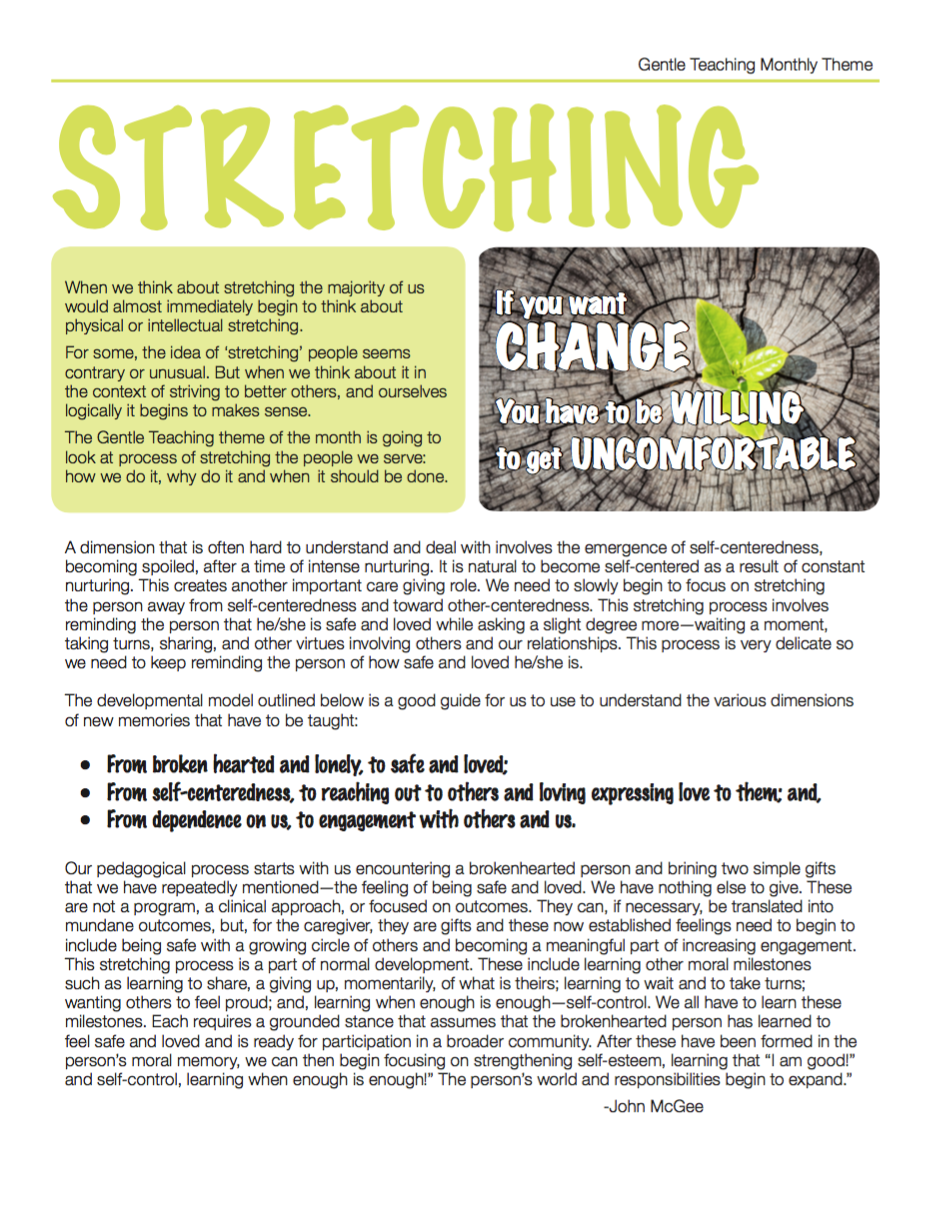
A dimension that is often hard to understand and deal with involves the emergence of self-centeredness, becoming spoiled, after a time of intense nurturing. It is natural to become self-centered as a result of constant nurturing. This creates another important care giving role. We need to slowly begin to focus on stretching the person away from self-centeredness and toward other-centeredness. This stretching process involves reminding the person that he/she is safe and loved while asking a slight degree more—waiting a moment, taking turns, sharing, and other virtues involving others and our relationships. This process is very delicate so we need to keep reminding the person of how safe and loved he/she is.

The developmental model outlined below is a good guide for us to use to understand the various dimensions of new memories that have to be taught:

• From brokenhearted and lonely, to safe and loved;
• From self-centeredness, to reaching out to others and loving expressing love to them; and,
• From dependence on us, to engagement with us and others.
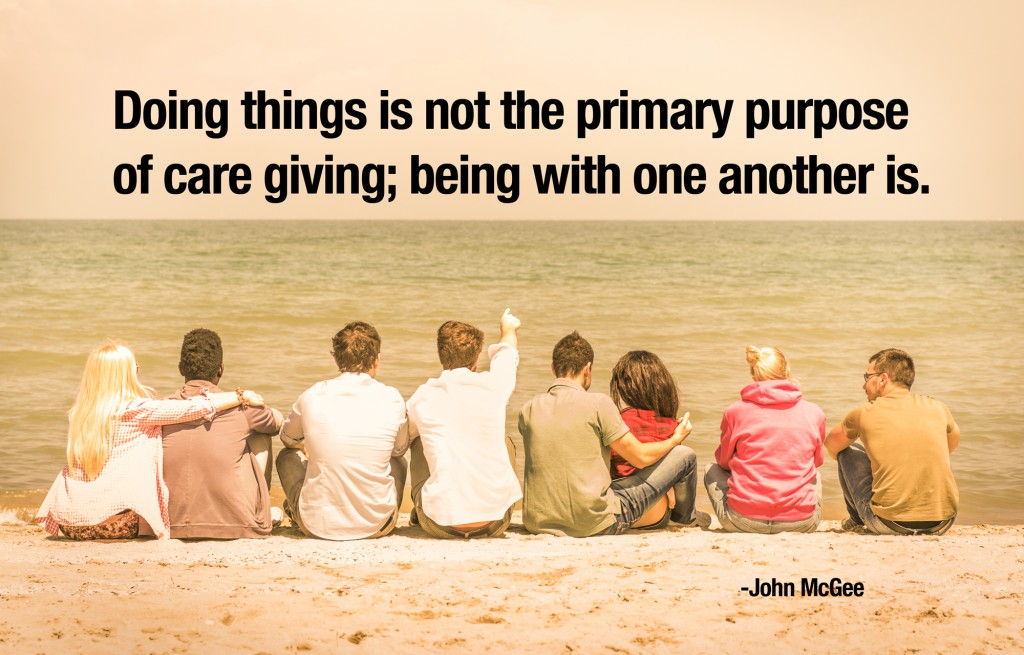
Doing-things-is-not-the-primary-purpose-of-care-giving-being-with-one-another-is

Our pedagogical process starts with us encountering a brokenhearted person and bringing two simple gifts that we have repeatedly mentioned—the feeling of being safe and loved. We have nothing else to give. These are not a program, a clinical approach, or focused on outcomes. They can, if necessary, be translated into mundane outcomes, but, for the caregiver, they are gifts and these now established feelings need to begin to include being safe with a growing circle of others and becoming a meaningful part of increasing engagement.

This stretching process is a part of normal development. These include learning other moral milestones such as learning to share, a giving up, momentarily, of what is theirs; learning to wait and to take turns; wanting others to feel proud; and, learning when enough is enough—self-control. We all have to learn these milestones. Each requires a grounded stance that assumes that the brokenhearted person has learned to feel safe and loved and is ready for participation in a broader community. After these have been formed in the person’s moral memory, we can then begin focusing on strengthening self-esteem, learning that “I am good!” and self-control, learning when enough is enough!” The person’s world and responsibilities begin to expand.

After an intense dimension involved almost solely with unconditional love, it is natural to enter a phase of self-centeredness. It is then that our role evolves into carefully and delicately stretching the still fragile brokenhearted person from a state of self-centeredness to one of other-centeredness. It is a process in which the person learns that it is good to be with a small circle of others, then it is good to do things with this group, and eventually it is good to do things with a wider circle of friends, and finally it is good to do things for others. This last encompasses a high form of moral maturity.

We also begin to focus on the person’s self-esteem. This milestone emerges when others keep reminding the person, “You are so good!” This begins to occur from the very start when we are teaching that it is good to be together. What happens in this process is that the person begins to feel safe and loved from within. As this occurs, the person begins to see him/herself in a different light and forms a moral memory that says, “I am somebody because my caregivers tell me I am.” As the circle of friends grows, the person’s sense of self-worth also expands and becomes stronger.”

– John J. McGee, PhD

The Caring Moment

In the beginning we must always be in the moment with two bits of knowledge focused on giving a feeling of being safe and loved. We should avoid lengthy case histories and cleanly typed plans. If need be, do these requirements. However, our task is to be in the moment; it is not to change anyone’s behavior, but to teach the person to feel safe with us and loved by us.

The present is a series of moments that tumble into the future. Yet, we should not worry about the future, only the present moment. The here-and-now becomes the future with each ticking second. Our encounters transpire in the moment and then transform the next moment.

The-joy-is-in-the-moments

Whether a mother, father, grandparent, or a person whom we are supporting, the most important variable is the moment, not the future, not a projected plan with outcomes, not behavioral change. No, it is our being present in this very moment and all the person sees, hears, touches, and feels in this mutual coming together. It is the tiniest amount of time, perhaps two or three seconds. Then, these moments are linked together with other moments and it is these moments that become new moments; it is the evolving chain of moments that creates our moral memory in us as well as a memory in the other person.

Caregiving’s simplification involves teaching caregivers to be in the moment:

  • In bad moments this equates with forgiveness rather than control;
  • In all the good moments this involves a series of accidental and intentional encounters throughout the day focused on safe and loved;
  • The accidental encounters are merely brief moments of passing by and encompass a wave, a wink, a smile, a name, a thumbs up, maybe a hug if there is time, a whispering of “You are so good.”
  • The intentional encounters are a bit more planned and involve a chunk of caregiving time—from a minute or two or a half hour or more. The time depends. It should be structured in the day with the only purpose being to give a memory that the person is safe when with us.
  • The key is to stay in the moment. Joy is found in the moment.

Our task is simple, just being in the moment with the gift of helping the person to feel safe and loved:

  • Not a moment before,
  • Not a moment after,
  • Just in the now.”

-John J. McGee, PhD

Gentle Teaching Theme for April 2015: Stretching

StretchingStretching - 2

Teaching Feelings of Safety and Security

“If we want to teach feelings of safety and security, we need to question what we are doing and how we are doing it. The key is to look at ourselves and ask, ‘ What do we represent to the person–love or domination?’ If we see the person as our equal and if we define our relationship as one of brotherhood and sisterhood, then the answer becomes more obvious. We commit ourselves to making certain that our presence signifies feelings of safety and security. Yet, we need to deal with the irony of representing these feelings while face to face with rejection, disruption, or even violence.

Our interactions have to signal warmth, serenity and tolerance.

Our interactions have to signal warmth, serenity and tolerance. From the first instance, we need to make sure that the person interprets our presence as representing nonviolence. Warmth emanates from a strong desire to be one-with-the other. We have to put in check many customary reactions–demands, harshness, and objectivity. Care giving is a very personal process that needs to summon forth feelings of friendship. At first, we should not expect acceptance since all of the person’s history says control is the rule. But, in time, the person will begin to see us as representing safety and security.”


-John McGee

Our Approach is Based on Moral Development

“Our approach is based on moral development. This is not a church thing. It is an internal feeling that we develop over time about what is good, who we are, and why we are on this earth. It is an inner change, a change of the heart. It is what most children learn early in their life about feeling safe and loved. It is what many of us have to re-learn when we are crushed by life’s sorrows.

So, we have to develop an understanding of basic moral values and teach these in an authoritative manner, not coming down on the person, but patiently and repeatedly teaching them. Morality is the way we feel and view our role in life. It is made up of our basic beliefs that are learned through our own life-experiences and ongoing reflection on our place in the world. It is formed deep down in our memories over time and with many experiences. Morality is on the fringe of our consciousness. We often do not have to stop and think, “Should I do this or not do that?” Our life-decisions come out of deep, deep memories. A spirit of gentleness focuses on teaching deep moral memories to people whose hearts are broken. Our primary strategy is repeated acts of love.

The first moral rule is found in a feeling of companionship– safe, loved, loving, and engaged. We know, without even thinking about it, that we need to feel safe and loved on this earth. We gravitate toward those who fulfill this sense and move away from those who make us fearful. Yet, many people whom we support are filled with fear of themselves and of others. We look for meaning in our lives and find it in our relationships with others other family, our children, our friends. Many whom we serve do not have this type of meaning.

The second is found in community– the goodness of being with others, engagement with others, and reaching out to others, and a sense of connectedness with others. It is a feeling of being collectively safe, loved, loving, and engaged. It moves from a singular relationship with the caregiver to a collective relationship with a circle of friends.

Companionship and community occur in a spiral. The initial relationship is at the center, but slowly spins outward to others. Everyone needs the feeling of being safe and loved to also feel loving and engaged. This evolves with one person, then two, then many.”


-John McGee, ‘Mending Broken Hearts’

Mentoring a Spirit of Gentleness

“Mentoring is a way to help teach others about gentle care giving, to enter into terrifying spaces and teach others to feel safe and loved.” Mentoring is an approach to do this. It is a way to share with others a spirit of gentleness and justice.

A mentors role is to define the empty and sometimes violent spaces that exist between caregivers and marginalized individuals in institutions, shelters, homes, prisons, nursing homes, schools and wherever we happen to serve. These places have to be filled up with the caregivers’ laces of affection–their loving touch, warm words, and kind gazes. Caregivers need to stop and reflect on the formation of companionship and community and the role of helping individuals feel safe, engaged, loved and loving. From this foundation, caregivers can then create communities of caring. Mentoring is a process for teaching caregivers to establish companionship and community.

Mentoring is a way to teach others

Mentoring is an ever-deepening task that calls for the development of trust among caregivers and the formation of a sense of companionship and community. This trust starts by the Mentor entering into the caregivers’ space with a deep sense of humility and justice and helping each caregiver feel safe and respected. It is the informal coming together of the Mentor and caregiver around the kitchen table and the sharing of the meaning of companionship and community. It is working together and finding ways to teach marginalized people these feelings.”

-John McGee

Psychology of Interdependence

“Regardless of the type of aggression, self-injury or withdrawal, we assume that a hunger for being-with-others rests in the human spirit, longs to be fulfilled, and , in many instances, needs to be uncovered. We struggle to uncover and fulfill this need in ourselves and others. We are often pushed by the fear of giving ourselves to others and pulled by the hope that such feeling give rise to. Our fear can lead us to lord over others in order to gain a false sense of power. But, the more we question our values, our hope can lead us to feelings of companionship. This pushing and pulling leaves us in a quandary–to reach out toward others or to preside over them. The desire to affirm the other is often buried in us by years of training that have taught us that independence is the central goal of life, and, for those who are on the fringes of community, compliance is the pathway to success.

Yet, self-reliance and blind obedience are lonely conditions that lock us and others out of the embrace of human warmth and affection. Those who are committed to care giving often do not recognize this struggle within themselves, let alone in the marginalized people whom they serve, So the first place to start in the psychology of interdependence is with ourselves, our values, and how we translate these into reality.”

John McGee

Reverse Effects

“We keep trying to establish feelings of companionship and forming community among those who are marginalized. Yet, we struggle to create a sense of connectedness in a culture that demands independence and self-reliance. We listen to newscasts that announce this. We hear newscasts tell us the strong must control the weak. We read newspaper stories that trumpet the glory of the self. These cultural attitudes become part of our care giving. We have been trained to seek compliance and control. We demand that those whom we serve choose what is right and good when they do not trust us, in fact, often fear us. We live in a world that places the individual above the community.

As care givers, we have to reverse this trend and begin to question what the other needs — to feel safe with us and loved by us. A psychology of interdependence assumes that we find ourselves in others and in the strength of our connectedness to others. It is the foundation of who we are and what we are becoming. It leads us to develop a sense of companionship with those who distance themselves from us. We have to move from a culture of self-reliance to one of human connectedness and from a culture of self to one of otherness. As we do this, we are slowly moving toward the formation of community where we will feel collectively safe, loved, loving and engaged.

Interdependence is based on our shared values — the wholeness and inherent goodness of each person in spite of violent behavior and the thirst that we all have for a feeling of being one-with-one-another in spite of paradoxical behaviors that push others away. These values are difficult to maintain, but are necessary if we are to help those who cling onto the slippery edge of family and community life.”

John McGee,
Mending Broken Hearts: Companionship and Community

See Worthy

At the age of eighteen I had applied for a job at a coffee shop in the city that I had been living in. I had visited this establishment numerous times and fell in love with it; at the time I had seen it as a place that screamed adulthood, something that I was craving in my life. To my surprise, I had been asked to come in for an interview; I was ecstatic! As I entered the meeting I was greeted by the manager. He asked me a few questions about my work experience, desire for growth and future plans that I had for myself. The overall interview didn’t span more than ten minutes before the manager offered me a position at his coffee shop; My teenage dream came true! For the next few minutes he talked to me about work expectations (what I should wear and when I would be trained). For the next twenty minutes the manager began to blast me with statements such as,

“I know people like your kind–you better not disappoint.”

“All you teenagers are the same.”

” If you ever dare to call in sick because you are hungover, you can guarantee yourself an early retirement from this job!”

Your boss woud never yell at you at COR

I left the interview feeling deflated and heart-broken. ‘How could I be treated like this?’ I thought to myself. I wasn’t seen as the person I am, but seen as a stereotype. In that moment any worth that I had was extinguished with a swift blow and no filter on a over opinionated mouth.

In the world today, the idea of worth is something that doesn’t go unnoticed. A person is able to see the value of ‘worth’ on a daily basis. Whether it is the constantly changing stock market which drives the worth of our currency, the title that falls before the name of a person, or the color of robe that is worn at graduation ceremonies; a person’s worth is often built upon standards that society has crafted over time. While economics, academics and professional titles are not the problem, we need to work hard at challenging our perspective. Think with me for a moment: When a baby is born there is something magical about the community that seemingly appears out of no-where to celebrate this thing we call life. As quick as we take a breathe, this baby has been given value and worth–yet as the child changes and grows into an adolescent and then an adult so does the societal view of worth. Choices are made; some good and some bad. As much as we hate to admit it, we are capable of becoming hardened towards people and deflating a sense of worth.

Our role as part of humanity, friends and supports in building the worth of another person can be viewed through the  lens of a child’s building block set; we have three options: We can either stand idly by and do nothing, which is of little value, we can build the tower of worth up, or we tear the tower of worth down. In his book, ‘Mending Broken Hearts’, Dr. John McGee says, “The self is seen not so much as independent or self-determining, but as connected with others who help the person feel worthy because he/she is safe and loved.” The choice is yours– but I would challenge you to build.

Ben, Director of Culture and Mentorship