We All Learn From Each Other

My most memorable time at COR has to be one of my more challenging days. We had just gotten back from a rough time at a softball game. The person I was supporting made a choice and ended up having to deal with some of the repercussions. When we got back home we had a really great heart to heart moment together. We talked and had a moment of learning together about what happened and why. I feel like it’s moments like these that I get up for everyday.

To go through life one step at a time and learn something valuable with every step we take

To go through life one step at a time and learn something valuable with every step we take. COR is an amazing place for everyone to come and learn. It’s not only the people we support that learn, but every person I have spoken to is truly impacted by the people we support in one way or another. We all learn from each other and its alright to make mistakes, as long as we pick ourselves up and are ready to try again.

Matt

COR Support

What is Community?

What is Community? from Creative Options Regina (COR) on Vimeo.

We need to rethink how we define “community”. People will say things like, “lets go out into the community”, when in fact we’re already IN community. We all make up the community; just being you makes you a part of it! Embrace what’s around you!

Unconditional Value

“Our experiences with Gentle Teaching have taught us that change needs to start with us–our warmth, tolerance and the translation of values into relationships based on companionship. Our interactions need to reflect warm caring and a spirit of oneness in spite of even intense rejection or rebellion. They need to begin to signal feelings of empathy and the understanding that the relationship will evolve into an authentic friendship even though initially it is quite lop-sided.

Our interactions need to centre themselves on love the person with unconditional respect during the best moments and the most difficult ones. We have to care about the other and express the feeling that we are with and for the person. Spit can be running down our face or slaps stinging on our arms, but we need to unconditionally value the other. We are asked to transmit this feeling through dialogue and sharing our life experiences with the other. Our task is to initiate this process in a spirit of human solidarity.

Warmth can be felt

Warmth can be felt in the tone of our voice, the sincerity of our gaze, and the serenity of our movements.

Tolerance is conveyed through patience in the face of aggression, respect in the face of rejection, and perseverance in the face of entrenched rebellion. Our values are the impetus within this process, and they need to be constantly questioned and deepened. It is this spirit that we have learned in our gentle teaching experiences–to break away from emotional homelessness, to rupture the cold grip of loneliness, and to center ourselves  on unconditional love.

The challenge is not to find non-aversive behavioural techniques, but to formulate and put into practise a psychology of interdependence that goes against the grain of modifying the other and asks for mutual change. This presents a major challenge to parents, professionals, and advocates. It requires an awakening of our values and putting them into practice in the most difficult situations.”


-John McGee

“Be A Superhero”

IN PRODUCTION–I’ve often wondered why are stories about superheroes so appealing? And why have they always been appealing throughout humankind’s history? (Recall the Roman and Greek gods and goddesses, and countless other myths of people with superhuman strength and power from all cultures throughout the world from all time.) If I was to give a less than educated guess as to their appeal, I would say that they touch something in us that we all long for…perhaps something missing from our very selves.

The reason I think this is because it seems too trite and easy to say that the appeal lies only in the fantastical. As if to say, just because those stories tell us of something that we do not see in real life they keep our attention. I can imagine a story with many fantastical details that would not make me rush to see the movie or buy the book. That is to say, fantastical does not always equal appealing.

So perhaps superheroes’ appeal lies in the fact that they are marked as special, set apart, different, but in a good way–a way that increases their human potential. I believe that is a better explanation of their universal appeal. I believe it appeals to us because we very rarely experience it ourselves.

If this lack is a common existential experience, what does that tell us about our ontological make-up? Why would we all universally experience the same lack or same desire? Were we meant for something greater? Did we, as a race, have a potential that we lost? Or do we intrinsically have it but lost our ability to see it clearly? Why the common yearning and desire?

And then, why do we feel a lack that we seemingly lack the ability to fill? Even recognizing that one desires to be “more” does not enable one to meet their own desire. Even the richest and most powerful people in the world often report that they feel this same lack in life, like something is still missing.

Perhaps finding out what really quenches that desire or fills that lack is the meaning of life.

What-are-you-fighting-for

1) Decide what you want to accomplish

Is there a specific task/dream that you want to accomplish for someone or with someone?

2) Pick a theme song

Don’t take yourself too seriously! Let loose and have fun

3) Decide what you stand for

What are you fighting for?


Defining Empathy

“Empathy is not pity.”

“It is a feeling of being-one-with-the-other. It is trying to understand and sense why a child or adult is acting in a particular way and reflecting on the cumulative impact of each persons life history–years of segregation, submission, and isolation that gnaw away at the spirit. It is a spirit of sharing our common humanity, and the belief that no one exists as a mere individual but that we all exist interdependently…Empathy does not mean over-protection. It comes from our knowledge of the other and ourselves, our reality, our vulnerabilities, and our strengths and weaknesses. It is caring about the others anger, frustrations and rejection instead of whether the other is obeying or producing.

Represent-kindness-serenity-and-peace

We need to represent kindness, serenity and peace. It involves recognition of the personal and social dimensions of what it means to be handicapped, mentally ill, poor or abandoned. It remains steadfast during the good times and bad, at the depths of fury and the heights of joy. Nobody is only a student, a client, a resident, homeless, poor, or powerless. Empathy drives us to uncover the human condition and reveal its fullness, our fragility in the face of life’s vicissitudes, or vulnerability to emotional disruption, and our need for being-with others. We need to consider that we are but one short from homelessness ourselves.”

-John J. McGee

Process of Stretching

“We teach “safe” by placing almost no demands on the person except for being with the person with a sense of just “being.” It is a tremendously important for one human being to teach another it is good to be near you. Nothing more, nothing less. This act of recognizing the brokenhearted person’s existence and goodness is a most powerful teaching-learning experience. At the same time, we need to engage in nurturing and finding relevant ways to express unconditional love without pressuring the person at all. This might seem weird, but the person will learn to feel safe if we lower our demands while increasing our goodness, kindness, and expression of love. We need to avoid putting the horse before the cart. Doing things is not the primary purpose of care giving; being with one another is.

A dimension that is often hard to understand and deal with involves the emergence of self-centeredness, becoming spoiled, after a time of intense nurturing. It is natural to become self-centered as a result of constant nurturing. This creates another important care giving role. We need to slowly begin to focus on stretching the person away from self-centeredness and toward other-centeredness. This stretching process involves reminding the person that he/she is safe and loved while asking a slight degree more—waiting a moment, taking turns, sharing, and other virtues involving others and our relationships. This process is very delicate so we need to keep reminding the person of how safe and loved he/she is.

The developmental model outlined below is a good guide for us to use to understand the various dimensions of new memories that have to be taught:

• From brokenhearted and lonely, to safe and loved;
• From self-centeredness, to reaching out to others and loving expressing love to them; and,
• From dependence on us, to engagement with us and others.
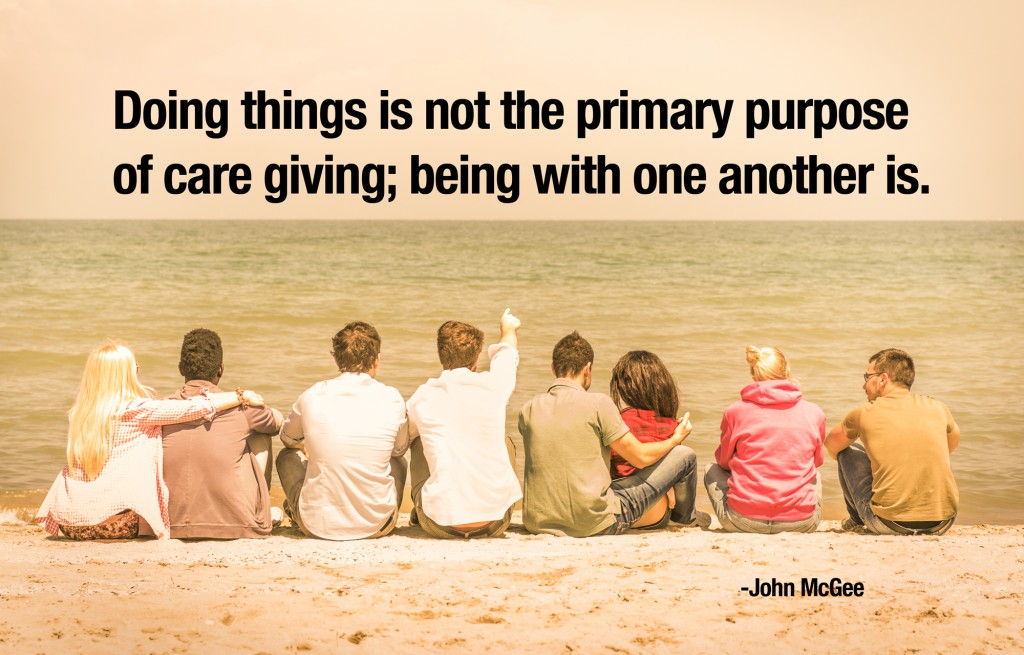
Doing-things-is-not-the-primary-purpose-of-care-giving-being-with-one-another-is

Our pedagogical process starts with us encountering a brokenhearted person and bringing two simple gifts that we have repeatedly mentioned—the feeling of being safe and loved. We have nothing else to give. These are not a program, a clinical approach, or focused on outcomes. They can, if necessary, be translated into mundane outcomes, but, for the caregiver, they are gifts and these now established feelings need to begin to include being safe with a growing circle of others and becoming a meaningful part of increasing engagement.

This stretching process is a part of normal development. These include learning other moral milestones such as learning to share, a giving up, momentarily, of what is theirs; learning to wait and to take turns; wanting others to feel proud; and, learning when enough is enough—self-control. We all have to learn these milestones. Each requires a grounded stance that assumes that the brokenhearted person has learned to feel safe and loved and is ready for participation in a broader community. After these have been formed in the person’s moral memory, we can then begin focusing on strengthening self-esteem, learning that “I am good!” and self-control, learning when enough is enough!” The person’s world and responsibilities begin to expand.

After an intense dimension involved almost solely with unconditional love, it is natural to enter a phase of self-centeredness. It is then that our role evolves into carefully and delicately stretching the still fragile brokenhearted person from a state of self-centeredness to one of other-centeredness. It is a process in which the person learns that it is good to be with a small circle of others, then it is good to do things with this group, and eventually it is good to do things with a wider circle of friends, and finally it is good to do things for others. This last encompasses a high form of moral maturity.

We also begin to focus on the person’s self-esteem. This milestone emerges when others keep reminding the person, “You are so good!” This begins to occur from the very start when we are teaching that it is good to be together. What happens in this process is that the person begins to feel safe and loved from within. As this occurs, the person begins to see him/herself in a different light and forms a moral memory that says, “I am somebody because my caregivers tell me I am.” As the circle of friends grows, the person’s sense of self-worth also expands and becomes stronger.”

– John J. McGee, PhD

Take a Stand Against a “Thanklessness Epidemic”

Over a year ago I started a personal blog where I would share my thoughts and insights on the world around me. It was my desire to write a post once a day for a year. I desperately wanted to keep it up, and did well for a time: but the personal pressure that I placed on myself became too much. The blog focused on one specific thing: the daily heroes that I would run into at work, at the grocery store, on the street and in the least unexpected places. My goal was to expose the beauty of the world around me and publicly thank the ‘daily heroes’ to my handful of faithful readers.  Although I haven’t logged a blog for some time, this thought of thankfulness has been constantly on my heart and mind. And dare I say, I think we are in a ‘thanklessness epidemic’. Don’t get me wrong, we can hear people say thank-you around us all the time, but is it anything more than a simple pleasantry or a moralistic mandate? We need to foster thankfulness and find moments where our deep appreciation is expressed in ways that it will be heard clearly and intentionally for what it truly is.

On the other hand, thanklessness is deeply tethered and connected to the inability to be content. When you are thankless, not only do you rob the other person of the glory that belongs to them, you convince yourself you could have gotten on fine without them. Author JD Greer says, ” Think of it (thanklessness) like plagiarism. Plagiarism is harmful on two levels: the first level is you rob someone else of the credit of their words. Secondly you delude others and yourself in thinking that you can come up with that level of idea all the time.” When we choose to be thankless, we turn our focus inwards and disregard others around us. We become so focused on “I”, “ME”, and  “MY” that we forget that is so often “OTHERS” that shape our life and it’s events. Although some people may like to live in a cavernous hermitage, most people need and want others around: let’s not forget our thankfulness often draws us into a greater sense on community.

Teaching thankfulness-is-not-to-be-seen-as-forcing-or-indoctrinating-someone,-rather-as-a-way-to-boldly-show-our-appreciation

In the Gentle Teaching community we talk about the four pillars (can anyone name them?): to be SAFE, to be LOVED, to become more LOVING AND to become more ENGAGED. Each one of these pillars are critical in building, establishing ans sustaining a relationship: with people we serve or otherwise. How do you help raise these pillars? One of the ways that I suggest is to increase the genuineness of our thankfulness. By becoming more thankful, and expressing our adoration and appreciation through words and actions we are directly able to help people feel safe and loved.

When I am genuinely thanked for something that I have done, I personally feel a deeper connection and appreciation for that person. Essentially I feel safe and more valued by that person, because they gave me both their time and words of affirmation. As we become more thankful around those that we serve we are teaching others to imitate what is good and right: we are teaching the foundation of healthy relationships. By modeling our genuine thankfulness before those we serve, we are teaching others to become more loving and engaged in their own lives. In essence we are saying, “Come, follow me…Do this..this is good and right.” Teaching thankfulness is not to be seen as forcing or indoctrinating someone, rather as a way to boldly show our appreciation to others and free those around us to accept, embrace and duplicate thankfulness in their own lives.

Got a story? I would love to hear about thankfulness in your life! Maybe it was someone that you noticed, or a story where you were edified because of someone’s courage to share their thankful appreciation with you. Send me a message at ben@creativeoptionsregina.ca


Signing-off,

Ben

Director of Culture and Mentorship


Teaching Feelings of Safety and Security

“If we want to teach feelings of safety and security, we need to question what we are doing and how we are doing it. The key is to look at ourselves and ask, ‘ What do we represent to the person–love or domination?’ If we see the person as our equal and if we define our relationship as one of brotherhood and sisterhood, then the answer becomes more obvious. We commit ourselves to making certain that our presence signifies feelings of safety and security. Yet, we need to deal with the irony of representing these feelings while face to face with rejection, disruption, or even violence.

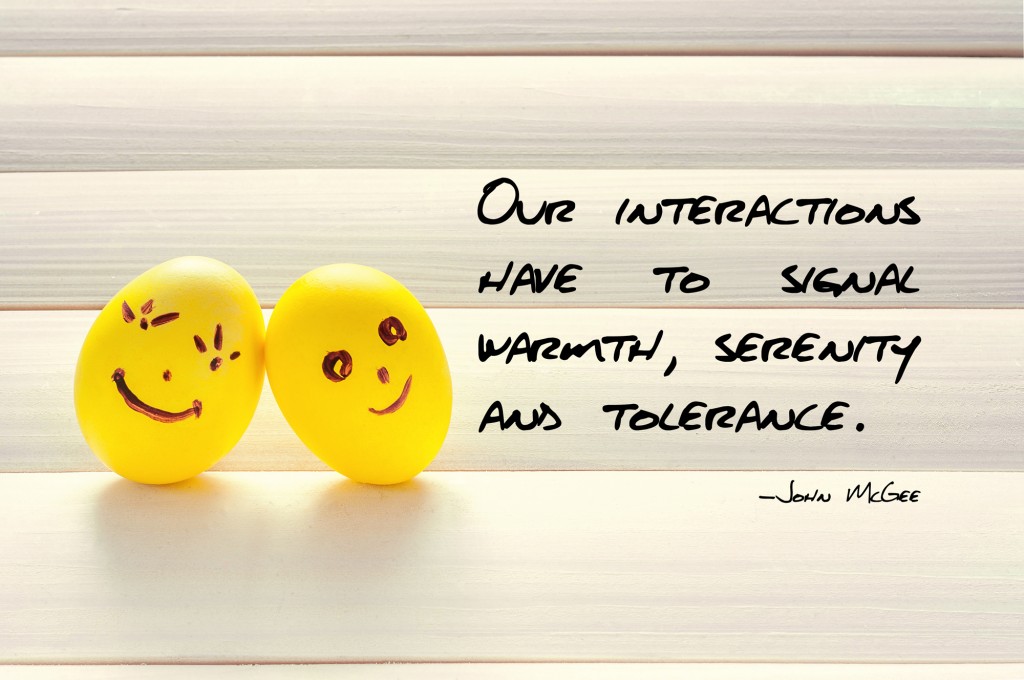
Our interactions have to signal warmth, serenity and tolerance.

Our interactions have to signal warmth, serenity and tolerance. From the first instance, we need to make sure that the person interprets our presence as representing nonviolence. Warmth emanates from a strong desire to be one-with-the other. We have to put in check many customary reactions–demands, harshness, and objectivity. Care giving is a very personal process that needs to summon forth feelings of friendship. At first, we should not expect acceptance since all of the person’s history says control is the rule. But, in time, the person will begin to see us as representing safety and security.”


-John McGee

Mentoring a Spirit of Gentleness

“Mentoring is a way to help teach others about gentle care giving, to enter into terrifying spaces and teach others to feel safe and loved.” Mentoring is an approach to do this. It is a way to share with others a spirit of gentleness and justice.

A mentors role is to define the empty and sometimes violent spaces that exist between caregivers and marginalized individuals in institutions, shelters, homes, prisons, nursing homes, schools and wherever we happen to serve. These places have to be filled up with the caregivers’ laces of affection–their loving touch, warm words, and kind gazes. Caregivers need to stop and reflect on the formation of companionship and community and the role of helping individuals feel safe, engaged, loved and loving. From this foundation, caregivers can then create communities of caring. Mentoring is a process for teaching caregivers to establish companionship and community.

Mentoring is a way to teach others

Mentoring is an ever-deepening task that calls for the development of trust among caregivers and the formation of a sense of companionship and community. This trust starts by the Mentor entering into the caregivers’ space with a deep sense of humility and justice and helping each caregiver feel safe and respected. It is the informal coming together of the Mentor and caregiver around the kitchen table and the sharing of the meaning of companionship and community. It is working together and finding ways to teach marginalized people these feelings.”

-John McGee

Psychology of Interdependence

“Regardless of the type of aggression, self-injury or withdrawal, we assume that a hunger for being-with-others rests in the human spirit, longs to be fulfilled, and , in many instances, needs to be uncovered. We struggle to uncover and fulfill this need in ourselves and others. We are often pushed by the fear of giving ourselves to others and pulled by the hope that such feeling give rise to. Our fear can lead us to lord over others in order to gain a false sense of power. But, the more we question our values, our hope can lead us to feelings of companionship. This pushing and pulling leaves us in a quandary–to reach out toward others or to preside over them. The desire to affirm the other is often buried in us by years of training that have taught us that independence is the central goal of life, and, for those who are on the fringes of community, compliance is the pathway to success.

Yet, self-reliance and blind obedience are lonely conditions that lock us and others out of the embrace of human warmth and affection. Those who are committed to care giving often do not recognize this struggle within themselves, let alone in the marginalized people whom they serve, So the first place to start in the psychology of interdependence is with ourselves, our values, and how we translate these into reality.”

John McGee