Real Work. Right Fit: How Two 4to40 Employees Help Feed Regina
When Austin goes on holidays, the Regina Food Bank notices.
“We need three volunteers to make the boxes that Austin can do in half a day,” said Jered Kirkland, Director of Operations at the Regina Food Bank. “We can’t deliver any food to our clients without the boxes.”
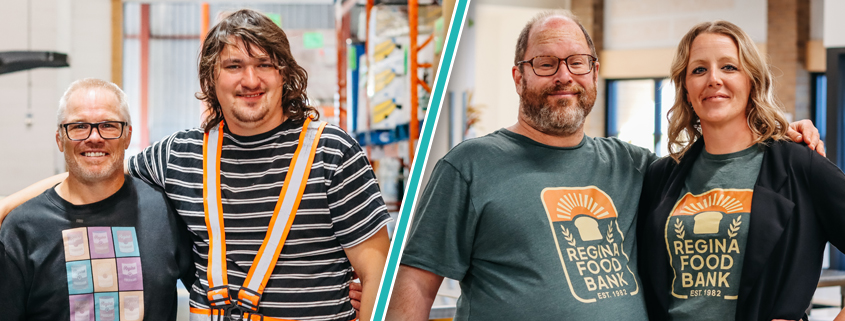
It’s a small detail with big stakes, and it’s the kind of work that keeps one of Regina’s busiest community organizations running. At the Food Bank’s warehouse and at the BMO Asahtowikamik Community Food Hub, two employees, Austin Coleman and Chris Paul, hired through the 4to40 Inclusive Employment Initiative, hold down roles the whole operation depends on.
Run through a collaborative partnership between Creative Options Regina and the University of Regina’s Campus For All program, 4to40 is an inclusive employment initiative that connects employers with job seekers who experience intellectual disabilities. Every role is customized to fill a real business need. It’s real work, not make-work.
Built Box by Box
Jered connected with Austin about five years ago, when he took on a bigger role in the warehouse. “With Austin, we lucked out,” he said.
Austin manages the Food Bank’s recycling, a passion he carries well beyond work. In the summer, he’s known around his neighbourhood for pulling a wagon or bike cart to collect recyclables. But his real specialty is boxes: the ones that carry food hampers to clients across the city.
“It’s every little piece,” Jered said. “People don’t necessarily understand how important it is. He’s an asset to our organization. We feed a lot of people every day, and that’s due to Austin’s box-making skills.”
Austin is just as comfortable with the CEO as he is with a part-time staffer or a volunteer, and that ease has made him part of the Food Bank’s culture.
“No matter how serious a conversation the leadership team is having, we know that door is going to open, and Austin is going to give us the ‘Okay, guys, see you tomorrow,'” Jered said.
“We all look forward to it.”
Finding the Right Fit
The Food Hub works like a neighbourhood grocery store: clients walk the aisles and choose their own food. “It normalizes it,” said Stephanie Wenger, manager of the Food Hub. “It’s just the same as going to a grocery store.”
Chris helps keep that store running, stocking the shelves and fridges and making sure everything looks its best. He started about two years ago with one shift a week. He loved it so much that he asked for more, and he now works two afternoons a week.
“He loves his job. He loves showing up every day,” Stephanie said. “‘I love my job’ — it’s something we hear three or four times every time he comes in.”
Finding his place started with paying attention. “When Chris started, we tried him out on everything,” Stephanie said. “You can see it on his face when he’s enjoying himself. That’s kind of how we discovered the fridge area.”
The fridges are now his favourite part of the job, and his attention to detail shows. “He will find the one mouldy lemon in the bag, and he will take that out and make sure it looks good and perfect.”
Like Austin, Chris is passionate about recycling. “If we throw one plastic thing in the garbage, we’re going to hear about it,” Stephanie laughed.
Chris worked one-on-one with supports when he first started. Today, he works mostly on his own, has his routine down, and regularly brings new ideas to the team.
“We’re the Lucky Ones”
For Stephanie, the dignity the Food Hub offers its clients extends to everyone who works there. “I never want anybody walking into the store feeling like they don’t belong, and that goes for clients, staff and volunteers,” she said.
That’s why, for both supervisors, inclusive hiring isn’t about doing anyone a favour. It’s about filling real jobs with the right people.
“It’s not a charity. We’re not doing anybody favours here,” Stephanie said. “He is simply our employee, and we’re treating him no different.”
Getting it right, she said, simply means taking the time to get to know someone, which is good practice for any employee. “Take the time to learn your employees. Learn what they like and what they don’t like, and make them a part of the plan.”
Jered sees the partnership as a long-term pipeline for talent. “It would be great to continue the partnership,” he said. “You might get a career individual if you go through this program.”
For any employer on the fence, Stephanie’s advice is simple: “Jump off that fence as fast as you can and dive on in.”
“We’re the lucky ones,” she added. “If anything, they’re doing us a favour.”
Learn More About 4to40
October is Disability Employment Awareness Month (DEAM). We’re sharing local stories that show what inclusive employment looks like in practice.
To learn more about inclusive employment and the 4to40 program, visit https://4to40.ca/.