COR’s Moving!

On June 1st, 2015 Creative Options Regina will be moving to a brand new location! 300-1162 Osler Street will be the new COR headquarters.

On June 1st, 2015 Creative Options Regina will be moving to a brand new location! 300-1162 Osler Street will be the new COR headquarters.
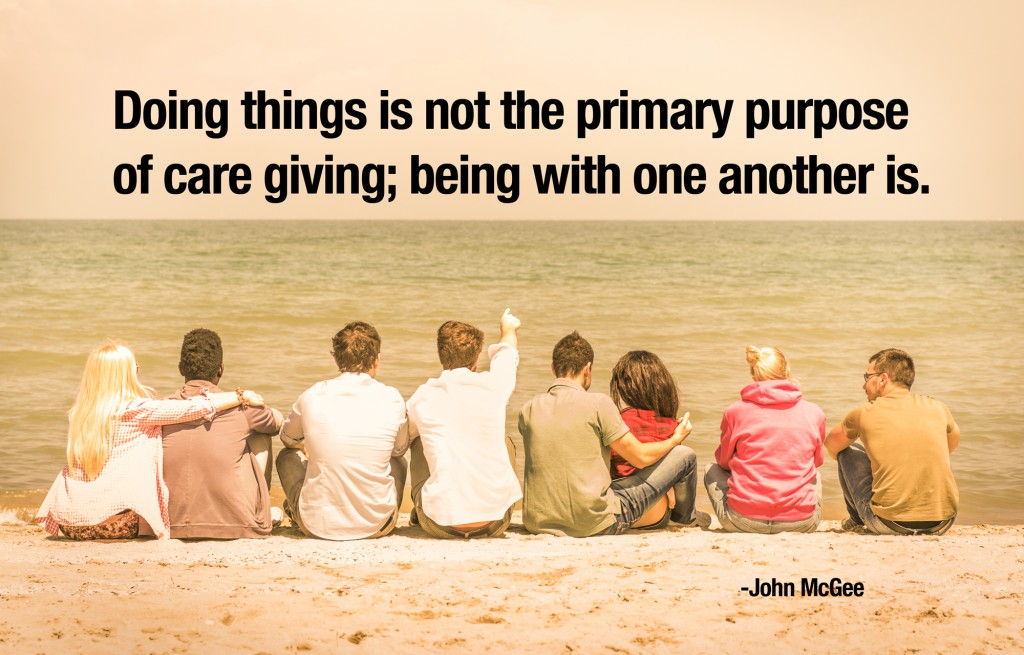
“We teach “safe” by placing almost no demands on the person except for being with the person with a sense of just “being.” It is a tremendously important for one human being to teach another it is good to be near you. Nothing more, nothing less. This act of recognizing the brokenhearted person’s existence and goodness is a most powerful teaching-learning experience. At the same time, we need to engage in nurturing and finding relevant ways to express unconditional love without pressuring the person at all. This might seem weird, but the person will learn to feel safe if we lower our demands while increasing our goodness, kindness, and expression of love. We need to avoid putting the horse before the cart. Doing things is not the primary purpose of care giving; being with one another is.
A dimension that is often hard to understand and deal with involves the emergence of self-centeredness, becoming spoiled, after a time of intense nurturing. It is natural to become self-centered as a result of constant nurturing. This creates another important care giving role. We need to slowly begin to focus on stretching the person away from self-centeredness and toward other-centeredness. This stretching process involves reminding the person that he/she is safe and loved while asking a slight degree more—waiting a moment, taking turns, sharing, and other virtues involving others and our relationships. This process is very delicate so we need to keep reminding the person of how safe and loved he/she is.
The developmental model outlined below is a good guide for us to use to understand the various dimensions of new memories that have to be taught:
• From brokenhearted and lonely, to safe and loved;
• From self-centeredness, to reaching out to others and loving expressing love to them; and,
• From dependence on us, to engagement with us and others.
Our pedagogical process starts with us encountering a brokenhearted person and bringing two simple gifts that we have repeatedly mentioned—the feeling of being safe and loved. We have nothing else to give. These are not a program, a clinical approach, or focused on outcomes. They can, if necessary, be translated into mundane outcomes, but, for the caregiver, they are gifts and these now established feelings need to begin to include being safe with a growing circle of others and becoming a meaningful part of increasing engagement.
This stretching process is a part of normal development. These include learning other moral milestones such as learning to share, a giving up, momentarily, of what is theirs; learning to wait and to take turns; wanting others to feel proud; and, learning when enough is enough—self-control. We all have to learn these milestones. Each requires a grounded stance that assumes that the brokenhearted person has learned to feel safe and loved and is ready for participation in a broader community. After these have been formed in the person’s moral memory, we can then begin focusing on strengthening self-esteem, learning that “I am good!” and self-control, learning when enough is enough!” The person’s world and responsibilities begin to expand.
After an intense dimension involved almost solely with unconditional love, it is natural to enter a phase of self-centeredness. It is then that our role evolves into carefully and delicately stretching the still fragile brokenhearted person from a state of self-centeredness to one of other-centeredness. It is a process in which the person learns that it is good to be with a small circle of others, then it is good to do things with this group, and eventually it is good to do things with a wider circle of friends, and finally it is good to do things for others. This last encompasses a high form of moral maturity.
We also begin to focus on the person’s self-esteem. This milestone emerges when others keep reminding the person, “You are so good!” This begins to occur from the very start when we are teaching that it is good to be together. What happens in this process is that the person begins to feel safe and loved from within. As this occurs, the person begins to see him/herself in a different light and forms a moral memory that says, “I am somebody because my caregivers tell me I am.” As the circle of friends grows, the person’s sense of self-worth also expands and becomes stronger.”
– John J. McGee, PhD

COR is pleased to we welcoming the return of Cara Milne to Regina to host two, one-day workshops on Finding Value in My Day! For more information, contact the COR office.
An inspiring speech by Lieutenant Governor Brian Calley given during the 2014 COG Conference in Michigan, USA.
“In the list that follows, compare how a person whom you serve struggles with fear and is distanced from a feeling of being safe. Reflect on the subtle interactions that the person expresses that show “I am safe with you” but always remember that we are not blaming ourselves. Yet, we need to gain insight into the fear that envelops those we serve. Look at each factor in the list and check those that apply. If fearful outweighs safe, then we know how important it is to teach the person a feeling of, “With us, you are safe!” Decide what major areas indicate fear. But, beware! We are not interested in focusing on behavior. They are only signs of a deeper anguish that is driven by deep fear and meaninglessness. Our full focus will be on dealing with fear. For now, get a sense of the fear that pervades the people we serve.
• Runs away
• Cries a lot
• Expressionless
• Sad appearance
• Slovenly
• Hits self
• Hits others
• Sleeps poorly
• Complains
• Refuses to participate
• Eats poorly
• Self-stimulates
• Curses
• Hordes
• Flinches
• Stays with others
• Expresses joy
• Relaxed
• Contented appearance
• Well-cared for
• Respects body
• Respects others
• Sleeps well
• Expresses love
• Enjoys participating
• Eats well
• Enjoys hobbies
• Uplifts others
• Shares
• Appears content
This initial analysis is a critical step for us since we often think that we do nothing to produce fear. We feel that the person is really “pretty happy.” Indeed, this may generally be the case. Yet, we have to look more closely. We might think that we do not do anything directly to cause fear. We might see the person as simply manipulative or seeking attention. We have to probe more deeply.
Our purpose is different. We choose not to control people. We choose to help them liberate themselves from fear and meaninglessness. We are not satisfied with, “Leave well enough alone!” We have to concern ourselves with the community of people whom we serve and teach all to live together. At school, home, work, or play, our task is to teach marginalized children and adults to feel safe with us and loved by us.”
John McGee
“Mending Broken Hearts: Companionship and Community”
I know that it is a strange question and if you chose to stop reading here I would likely understand. But I promise you, I’m on to something. Now I am not talking about the physicality of your walk: do hips sway with a hoola-hoop like action, or is one leg shorter than the other causing a noticeable limp. More so, when you walk with a friend or companion, do you walk as if it is the end of the world and speed to wherever your destination may be or do you walk intentionally taking in your surroundings and the conversation that you may be having.
For the past three years I have been married to the love of my life. It has been an incredible adventure and we have enjoyed every minute of it: including the bountiful walks that we have taken. However one of the things that I noticed early on into our marriage is that my wife walks as if she is an Olympian speed walker–it eventually got to the point where I had to tenderly grab her hand and ask her to slow down. To ally my naysayers out there, it wasn’t because I couldn’t keep up to her, rather I didn’t like the feeling of being rushed in moments where I felt like I could relax.
I have been thinking about this idea of “pace” for a long time and it finally struck me: the way we pace ourselves not only determines when we finish the proverbial race, but also how we finish it. As supports, friends, family and others associated with COR and the Gentle Teaching movement has this idea fully penetrated our hearts and minds, thus being embodied in our words and actions? I ask this because I was convicted about it in my own heart, when I began noticing the young man that I support was always a few steps behind me. At first I didn’t think much of it, but as time passed I was frustrated: not at him, but myself. I had become the ‘Olympian’, though accomplishing much, missing the view.
So do me a favor, after reading this blog: stop whatever you are doing and ask yourself a few questions:
a)Loving Eyes/Gaze
b) Hands
c) Loving Words
d) Loving Presence
Ben, COR Support
Gentle Teaching is grounded in the whole person and who the person is. A key assumption, especially when supporting those who are extremely violent toward others or harmful to themselves, is the understanding that behaviors have their origin in moral development—how human beings throughout their lives are in the process of learning how to interact with others and how each of us sees ourself and others. This moral development is inside of us and encompasses the memories that have been formed from the first moments of life to the present moment.
Moral memories are how we spiritually interact with the world. When these memories are sad and disorienting, they reside like haunting ghosts in the hidden corners of our being and, in a sense, whisper to us what clinicians will later call behaviors. Behaviors are the visible part of toxic weeds; memories are the roots. They are deep, often not known, and not intellectual, but moral memories. The use of behavioral techniques is like pulling out the surface of weeds but leaving the roots intact. Gentle Teaching goes for the creation of new moral memories that eventually lead the person to feel safe and loved and then “behaviors” begin to fade away.
John J. McGee
It is not even about getting rid of behaviours. These will disappear or diminish as time goes by as a result of the person trusting us. It is not about any behavioural techniques that might be spelled out in a behaviour plan. If a caregiver enters anyone’s space with such intentions, the time spent will have nothing to do with Gentle Teaching. It is a contradiction to anxiously lead with an attitude of, “I have to change this behaviour or that one.”
The central and guiding focus for all caregivers is to help the person learn to feel safe and loved and this requires the prevention of any sort of harm. It is simply wise to not provoke any violence. Prevention gives caregivers the opportunity, space, and time to teach new memories of feeling safe and loved. Doing this dissipates or eliminates maladaptive behaviours as a direct result of feeling safe and loved. This has to be part and parcel of the caring community.
John J. McGee, 2012