Intersecting Identities: Understanding Disability, Gender & Sexuality with Natalya Mason
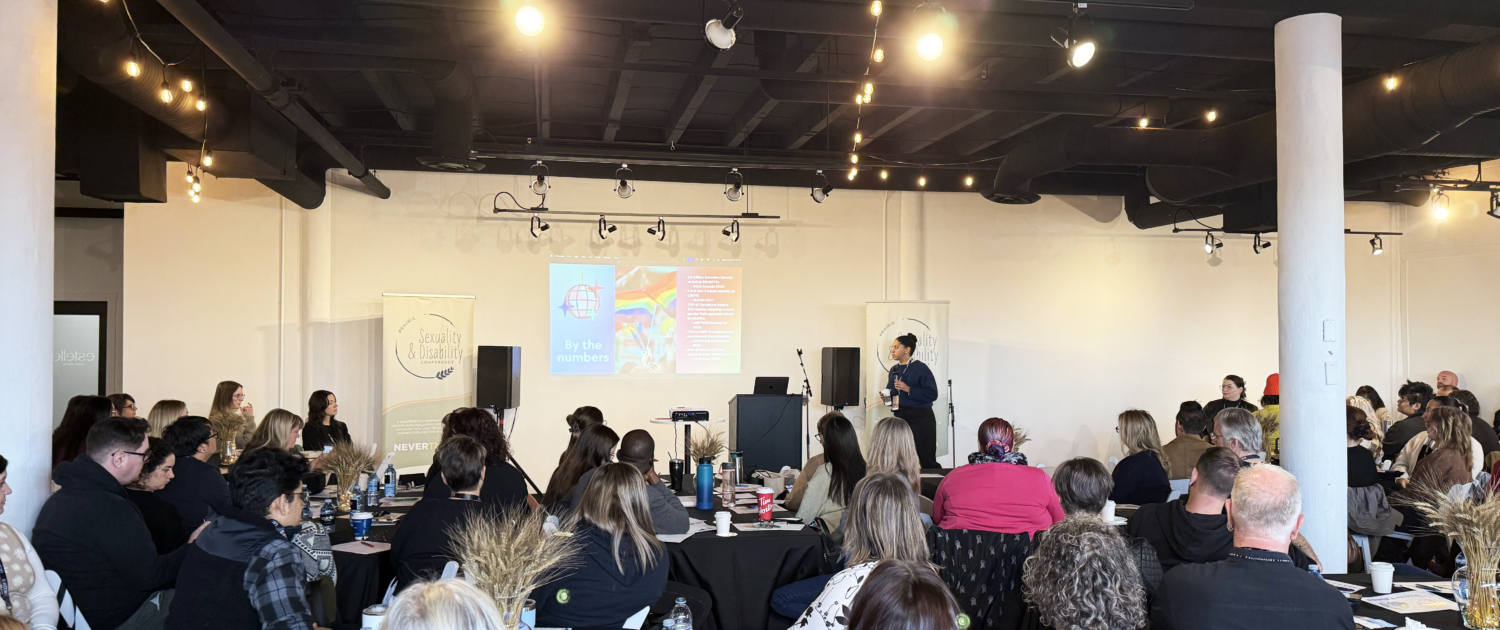
At the 2025 Prairie Sexuality & Disability Conference, keynote speaker Natalya Mason – consultant, social worker, and sexual health educator – opened day one with a deeply informative session exploring how disability, gender, and sexuality intersect in people’s lives. Her presentation invited attendees to rethink long-held assumptions and to approach identity with curiosity, humility, and respect.
Natalya began with a clear message: every person has a gender identity, a sexual orientation, and a way they express themselves – including people with disabilities. Yet social narratives often deny or minimize this truth. Cultural myths, ableism, and queerphobia shape the way people are seen, and these layered biases can deeply affect self-expression, autonomy, and well-being.
A Framework Rooted in Liberation, Justice & Sex-Positivity
Natalya grounded her keynote in three guiding frameworks: theory as a liberatory practice, reproductive justice, and sex-positivity.
She described theory as a liberatory practice as an invitation for everyone – not just academics – to examine the world around them and imagine something better. When marginalized people are given space to reflect on their experiences, she said,
“the closer we get to collective liberation and freedom for everybody – and to a world where they have the freedom to thrive, and the freedom to love who they want to love and love how they want to love.”
Reproductive justice, drawn from Black women’s organizing, reminds us that people have the right to have children, not have children, and raise children in safe and healthy communities. For Natalya, this framework naturally includes 2SLGBTQ+ people and people with disabilities, and links sexual health to broader struggles against racism, poverty, and state violence.
Sex-positivity, she added, means recognizing sexuality as an “enhancing part of life” and working not only to prevent negative experiences but to “produce ideal experiences for people, instead of solely working towards preventing negative experiences.”
Language, Power & Identity
A central theme of the keynote was language as a tool of power. Natalya noted that power “often maintains itself by keeping other identities or other experiences silent, and it will literally do that by not providing people the language to talk about something.”
Many of the terms used to describe gender, sexuality, and disability may feel new to some audiences – not because these experiences are new, but because people have been discouraged from naming them. Natalya encouraged participants to keep learning, ask questions, and follow the language people choose for themselves.
She walked through her “Identity Pal” tool, which helps break down identity into:
- Gender identity (who you know yourself to be)
- Gender expression (how you present to the world)
- Sexual orientation (who you love or are attracted to)
- Biological sex (chromosomes, hormones, anatomy)
These elements are related but distinct – and understanding that difference is key to offering respectful support.
Gender & Disability as Social Constructs
Natalya spent time unpacking the idea of social constructs – systems humans create, maintain, and can change. Gender is one of them. Using examples like the history of pink and blue clothing for babies, she showed how norms around “masculine” and “feminine” shift over time.
She also challenged the idea that biological sex is simple, noting that there are many intersex variations. “People tend to think that those conditions are really, really rare,” she said, “but there are about the same number of people in the world who are intersex as there are people who are born redheads.”
Disability, too, can be understood socially: rather than seeing a “broken body” that needs to be fixed, the social model of disability asks how environments, attitudes, and systems create barriers – or remove them. Curb cuts, Braille, and accessible design are all examples of how society can shift responsibility away from the individual and toward collective inclusion.
Intersections, Myths & Compounded Barriers
Drawing on the concept of intersectionality, Natalya talked about how identities combine and compound. Her experience is not just about being a woman, or Black, or queer, but about being a queer Black woman – and how those layers shape her life. Similarly, people who are both experiencing disability and part of the 2SLGBTQ+ community can face higher rates of discrimination, mental health challenges, and barriers to accessibility.
She named common myths about disability and sexuality – like the idea that people with disabilities are asexual, necessarily heterosexual, or unable to understand their own gender or orientation – and connected them to old, harmful narratives about queer people more broadly.
This isn’t theoretical: it affects who gets information, whose relationships are taken seriously, and whose rights are respected.
Allyship as Action
Natalya closed with practical guidance on allyship, emphasizing that good intentions are not enough. “All of us are accountable to both our intentions and the impacts of our actions,” she said. “Ultimately, the impact matters more than the intent.”
She encouraged participants to:
- Use people’s chosen names and pronouns
- Practice gender-neutral language
- Avoid making assumptions about gender, sexuality, or disability
- Correct themselves proactively when they make mistakes
“The term ally – think about that as a verb, not a noun,” she added. “You don’t just get issued an ally card and then you never have to renew it. Allyship is something that you should be actively engaged in and always working on.”
Natalya closed with a quote from bell hooks, reflecting on queerness as “being about the self that is at odds with everything around it, and has to invent and create and find a place to speak and to thrive and to live.” For many people with disabilities and queer people, that description resonates deeply.
Her hope – and the hope of the conference – is that we build communities where people no longer have to fight for a place to exist, but are supported to explore, express, and celebrate who they are with dignity and pride.