Brian Calley’s Remarks at the 2014 Culture of Gentleness Conference
An inspiring speech by Lieutenant Governor Brian Calley given during the 2014 COG Conference in Michigan, USA.

An inspiring speech by Lieutenant Governor Brian Calley given during the 2014 COG Conference in Michigan, USA.
If I could get away with never working out I would be an incredibly happy man! However, there is something strange that began happening to me once I graduated high school; my ‘average size’ frame began morphing into something that resembled the shape of a Teletubby. What was described to me as the ‘freshmen fifteen’, in reality became the freshman thirty-five: I had lost control!
Instead of crossing my fingers and wishing for the weight to miraculously dissolve, I made the hard choice to eat better and begin working out. At first going to the gym was incredibly intimidating; but with every time I kept my commitment, it became easier and more comfortable. Once again I began noticing changes. I felt healthier, stronger and my shoulders became more defined.
Shoulder’s aren’t typically something that you wake up thinking about: unless you are an Olympic body-builder and yet my post today focuses our attention on this idea: Do not be dismayed, this is a challenge that runs significantly deeper than the physical. I believe that we as living and breathing people need to continually ask ourselves, ‘what am I able to bear and what is my breaking point?’ This question comes to mind after weeks and months of dwelling on the question “whose responsibility is it?” Particularly thinking about the disability sector and the desire on COR’s behalf to be leaders within our community by embracing Gentle Teaching—and challenging the status-quo.
Whose responsibility is it when the police are called to a house because of a yelling match between roommates? Whose responsibility is it when a customer in line at the grocery store glares cruelly at the person we support, and utters comments under their breath? Whose responsibility is it to put the house together after an escalation that resulted in property damage? I’ll stop here, but please don’t think that this is a compulsive list—No! It can entail anything and everything that falls within a grey area, including care for those that we support as well as those that we support with.

On going relationships should motivate us to dig into unconditional love and share the load of others burdens. Giving the emotional encouragement and mental strength, so that the love of friendship spurs on that individual to continue. We have often said that we desire to work in a community of like-minded people: in order to do this we need to learn to carry the burdens and stress of others. Assist where needed and when available in order to bulk up our shoulders.
From my meager perspective, the greatest way to do this is to question your intent in everything. Are you noticing the down-trodden parent, the intimidated support worker or the overwhelmed team leader? Or, are you so caught up in the happenings of your own life that others are hidden in the background: with a painted banner over their heads that convinces you they are “happy”, “fine” or “will pull through with time”. I am convinced that we need to learn to become more intentional, bend down to help the helpless and bulk up our shoulders to carry the burden of others.
Ben, Director of Culture and Mentorship
Every year, on December 3, people all over the world come together at various events to celebrate International Day of Persons with Disabilities (IDPD). This international celebration of difference and understanding was established in 1992 by the United Nations, and seeks to encourage those worldwide to consider new perspectives in order to fully promote inclusion of people with disabilities in all aspects of our social, cultural, and economic spheres. Each year the theme is different and highlights a new and important topic – this year’s theme was “Sustainable Development: The Promise of Technology.”
Over the summer of 2014, many individuals that receive support through Creative Options Regina (COR) had the opportunity to take a 6-week course through the Regina and District Association for Community Living called “Let’s Connect – Sharing your Awesome with an iPad.” The individuals who attended learned all about how to utilize the wonderful world of technology and expand their ability to communicate and deepen their sense of community through the use of an iPad. At the end of the course they got to take their iPad home and make it unique to their own needs and interests. Many individuals now connect through iMessages, e-mails, FaceTime, Facebook and other social media platforms; many utilize their camera feature to take and share photos of their family, friends, activities, and favorite things; many utilize speech applications or other assistive or educational tools; and of course all of the fun stuff such as YouTube, games and silly apps! The list of ways in which these individuals use their iPads to expand their world goes on and on, and it has been truly incredible to see.

In September 2014, two UofR Kinesiology and Health Studies students, Megan Barss and Leah Fiorante, were given the task of creating an event that brings awareness to IDPD as a requirement for one of their classes. Megan and Leah had heard about “Let’s Connect” and watched the videos that Strategy Lab created to broadcast what the course was all about. Megan and Leah thought it would be great to do a follow-up video of how “Let’s Connect” and technology in general has aided in improving accessibility, community, and connection for those within COR who now utilize their iPads frequently. Over the course of a few months, and many meetings and correspondence, “Tech Talks” was brought to life.
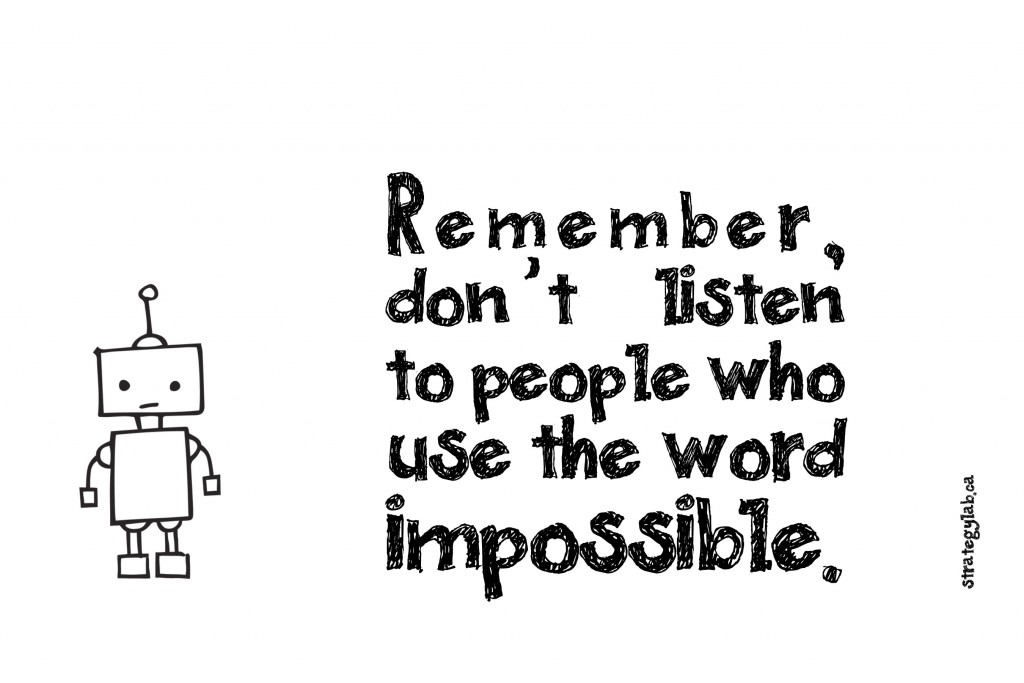
“Tech Talks” was held at the Science Centre on December 2nd 2014. There were approximately 50 people in attendance, all of different abilities, ages, and backgrounds. “Tech Talks” began with some appetizers and wine, and as people began to socialize the room grew with excitement and interest. The first speaker of the evening was Jeph Maystruck, who works at Strategy Lab and is involved with many other initiatives across Regina. Jeph spoke about how technology is influencing our society as a whole, and he captivated the audience with his discussion around never saying something is “impossible” and continually seeking new opportunities and potential for growth. It also doesn’t hurt that Jeph gave out lottery tickets to the audience members who answered his questions – he expanded our minds and our wallets! Jeph began the evening by instilling a sense of hope and inspiration in the audience, which laid the foundation for an evening that was all about capabilities and reaching goals never thought possible with the help of technology.
The second speaker of the evening was Kevan McBeth, who has been an advocate for people with disabilities for over 11 years, which began after the birth of his daughter Lauryn who was born with Down Syndrome. Kevan spoke about how important technology can be for those with disabilities, and in particular the ways in which technology has allowed his daughter Lauryn to grow and learn in a way that is unique and appropriate to her individual needs. Kevan spoke about many apps that can be downloaded to assist with spelling, math, or writing, as well as features such as Siri, which acts not only as a companion for many, but also encourages people to annunciate and speak fluently in order to have their commands understood. Skills such as this are transferrable to real life situations and are taught through the apps in a way that is patient, understanding, and at a pace that is appropriate to the individual. Kevan shared many stories of how technology has allowed individuals, and in particular his family and his daughter, to connect and communicate on a new level, which most often has a positive impact on the persons overall quality of life.
The third speaker was Stacey Laing, who is the coordinator of the “Let’s Connect” program at RDACL. Stacey shared with the audience the ways in which she has seen people grow and flourish as a result of utilizing their iPads. Stacey shared many inspirational stories about individuals who now get their needs met by taking photos of groceries and other items they want and then sending these pictures to their supports; individuals who now connect with old friends, supports or family who they had previously lost touch with; individuals who have never had a meaningful item all to themselves and who now find such pride and joy in using their iPad; and many more amazing stories of success and growth. Stacey stated that “Let’s Connect” is expanding and many other organizations within the province are receiving training on the course and are now rolling out the program in their own districts. Upon conclusion of Stacey’s discussion, the follow-up video of the “Let’s Connect” course that was created specifically for IDPD was shown – it can be viewed here:
Tech Talks: In Celebration of the 2014 International Day of Persons with Disabilities from Creative Options Regina (COR) on Vimeo.
After the video was shown, I, Kasey, invited up 4 individuals from COR who had participated in the “Let’s Connect” program to share their own stories of the ways technology has impacted their lives. First, Erin joined me on stage and discussed how she utilizes her iPad for school and connecting with friends and supports. Next, Patrick came on stage and discussed how he uses his iPad to connect with friends over various social media platforms, as well as how he utilizes apps such as the Weather Network to help plan his day accordingly. He also discussed his hope to eventually use a transit app to aid in planning his transportation around the city. Next, Ruby came on stage and shared her love for YouTube and watching craft videos. Ruby even brought a wooden crossbow that she made by watching an instructional video – but don’t worry, nobody was hurt during the display of the crossbow… it was made out of wooden sticks and rubber bands! Last but not least, Andrew joined me on stage and spoke to the audience about how he loves to use the calculator app to figure out the exact hours, minutes, seconds, and milliseconds that a person has been alive – he is very creative with the use of his iPad! All 4 of these individuals use their iPads in different ways that are special to their own interests and needs, and it was great to hear from them about how technology has improved their ability to communicate and connect.
After Erin, Patrick, Ruby and Andrew shared their stories, Tech Talks came to a close. Many people stayed after to mingle, ask questions, and network. There was a buzz in their air that is difficult to describe… It felt as though there was a common feeling of hope and inspiration in the room. I feel that “Tech Talks” encouraged those in attendance to strive to consistently challenge their ideas of what people with disabilities are capable of and to always see the ability in others in order to continually provide opportunities for inclusion and growth for those with disabilities in all spheres of our communities. We can all utilize the brilliant world of technology to help bring to life each individuals unique and valuable strengths, to help formulate and accomplish individual goals and understand and appreciate everyone’s abilities and desire to be included and contribute to our communities in a meaningful way. Technology has shaped our world in ways that were never thought possible. Technology has allowed for us to uncover medical and scientific discoveries that have never been explored before, to travel to unknown depths and spaces to find new species and cultures, to share ideas and spark movements with people across the world that shape our social and political realms each day… It is time that we fully include the population of individuals with diverse abilities into this wonderful world of technology. The world as we know it can be shaped and inspired by the unique and valuable perspectives of those with disabilities, all of which can happen at the simple touch of a screen.
Kasey, COR Support
“In the list that follows, compare how a person whom you serve struggles with fear and is distanced from a feeling of being safe. Reflect on the subtle interactions that the person expresses that show “I am safe with you” but always remember that we are not blaming ourselves. Yet, we need to gain insight into the fear that envelops those we serve. Look at each factor in the list and check those that apply. If fearful outweighs safe, then we know how important it is to teach the person a feeling of, “With us, you are safe!” Decide what major areas indicate fear. But, beware! We are not interested in focusing on behavior. They are only signs of a deeper anguish that is driven by deep fear and meaninglessness. Our full focus will be on dealing with fear. For now, get a sense of the fear that pervades the people we serve.
• Runs away
• Cries a lot
• Expressionless
• Sad appearance
• Slovenly
• Hits self
• Hits others
• Sleeps poorly
• Complains
• Refuses to participate
• Eats poorly
• Self-stimulates
• Curses
• Hordes
• Flinches
• Stays with others
• Expresses joy
• Relaxed
• Contented appearance
• Well-cared for
• Respects body
• Respects others
• Sleeps well
• Expresses love
• Enjoys participating
• Eats well
• Enjoys hobbies
• Uplifts others
• Shares
• Appears content
This initial analysis is a critical step for us since we often think that we do nothing to produce fear. We feel that the person is really “pretty happy.” Indeed, this may generally be the case. Yet, we have to look more closely. We might think that we do not do anything directly to cause fear. We might see the person as simply manipulative or seeking attention. We have to probe more deeply.
Our purpose is different. We choose not to control people. We choose to help them liberate themselves from fear and meaninglessness. We are not satisfied with, “Leave well enough alone!” We have to concern ourselves with the community of people whom we serve and teach all to live together. At school, home, work, or play, our task is to teach marginalized children and adults to feel safe with us and loved by us.”
John McGee
“Mending Broken Hearts: Companionship and Community”
• Our nonviolence
• Our sense of social justice
• Our expression of unconditional love
• Our warmth toward those who are cold
• Our teaching others to feel safe, loved, loving, and engaged
• Our teaching a feeling of companionship with the most marginalized
• Our forming community
• Our sense of human interdependence and solidarity
• Our option to be side by side with the most devalued
A spirit of gentleness might seem easy; but, always remember, we do things that many can interpret as cold and controlling, often without even realizing it. The cold space that exists between us and the vulnerable person deepens and broadens without us even realizing it when we focus on control with a “Do this or else!” mentality or when we wallow in hopelessness with an attitude of “Well, that is just the way she is.”
Without even realizing it, our tone of voice, our posture, the way we look at someone, and the way we talk can tell the vulnerable person strong messages that say, “You are no good! Do what I tell you to do or else!” We do not do this intentionally. Yet, if we do not understand human vulnerability and fragility, our simplest actions can take on a horrendous meaning. Our priorities are often messed up if we focus on behaviors instead of feelings or independence instead of interdependence. We need to worry about helping each person begin to feel more safe and loved instead of getting rid of behaviors.
John McGee
“Mending Broken Hearts: Companionship and Companionship”
“As care givers, we need to be well grounded. Our hope is not in independence, but interdependence. Our primary task is not to control others or force others to be what we want them to be or do what we want them to do. It is to bring a deep unconditional love to those whom we serve. Our central purpose is not self-determination or self-reliance; it is a feeling of connectedness between those whom we serve and ourselves. Our central role is to express a profound sense of companionship and community. What we often think are our primary tasks will come in due course if those whom we serve feel safe, loved, loving and engaged.
We are community makers. Community is a gathering of gifts. Our gift in the act of care giving is the creation of companionship and the formation of community. Those whom we serve bring their mind-body-spirit, their dreams denied, and their hunger for love. They bring their troubles and sorrows, their life story, and their broken hearts. We are to bring a spirit of gentleness to mend their hearts.”
John McGee
‘Mending Broken Hearts: Companionship and Community’
Communicate “YOU ARE SAFE!”– We are safe together. Don’t focus on the behavior. Respond to the feeling state. When we are upset, we are driven by emotion and physical arousal, not intellect.
Reduce Demands– Our tolerance for demands is an ebb and flow; changes from one moment to another. Be sensitive and flexible. Meet the person where they are at.
Do not linger in conflict– No feeling lasts forever. Every day is a new day. Reach a state of calm, re-engage and move on.
Check your expectations at the door– Whatever happened yesterday, let it go. What do you want the culture of your support time to look like and what can you do to make it happen.
Ask for help from your supports– Teams members, management and administration
Have hope– Try to reflect on your past relationship with the person you serve. Appreciate the steps toward growth no matter how big or small.

Introducing an exciting new initiative between COR and SAI: Our First Ever Caregiver Exchange! Interested Supports are encouraged to contact Melanie or Jim for more details!