Posts

We Need To Be The Most Loving During The Worst Moments

“We often see ourselves as better than those whom we serve and express this in talking down to those who are troubled, acting condescendingly, separating ourselves from their lives, and making sure that we are in control instead of dialoguing. Our task as caregivers is companionship and community. Our culture makes it harder because there is an expectation that we must control others by withholding ‘positive attention’ when someone is acting out. Our position is the opposite. We need to be the most loving during the worst moments.

-John McGee

Our role as caregivers is to provide community and companionship

Defining Empathy

“Empathy is not pity.”

“It is a feeling of being-one-with-the-other. It is trying to understand and sense why a child or adult is acting in a particular way and reflecting on the cumulative impact of each persons life history–years of segregation, submission, and isolation that gnaw away at the spirit. It is a spirit of sharing our common humanity, and the belief that no one exists as a mere individual but that we all exist interdependently…Empathy does not mean over-protection. It comes from our knowledge of the other and ourselves, our reality, our vulnerabilities, and our strengths and weaknesses. It is caring about the others anger, frustrations and rejection instead of whether the other is obeying or producing.

Represent-kindness-serenity-and-peace

We need to represent kindness, serenity and peace. It involves recognition of the personal and social dimensions of what it means to be handicapped, mentally ill, poor or abandoned. It remains steadfast during the good times and bad, at the depths of fury and the heights of joy. Nobody is only a student, a client, a resident, homeless, poor, or powerless. Empathy drives us to uncover the human condition and reveal its fullness, our fragility in the face of life’s vicissitudes, or vulnerability to emotional disruption, and our need for being-with others. We need to consider that we are but one short from homelessness ourselves.”

-John J. McGee

Process of Stretching

“We teach “safe” by placing almost no demands on the person except for being with the person with a sense of just “being.” It is a tremendously important for one human being to teach another it is good to be near you. Nothing more, nothing less. This act of recognizing the brokenhearted person’s existence and goodness is a most powerful teaching-learning experience. At the same time, we need to engage in nurturing and finding relevant ways to express unconditional love without pressuring the person at all. This might seem weird, but the person will learn to feel safe if we lower our demands while increasing our goodness, kindness, and expression of love. We need to avoid putting the horse before the cart. Doing things is not the primary purpose of care giving; being with one another is.

A dimension that is often hard to understand and deal with involves the emergence of self-centeredness, becoming spoiled, after a time of intense nurturing. It is natural to become self-centered as a result of constant nurturing. This creates another important care giving role. We need to slowly begin to focus on stretching the person away from self-centeredness and toward other-centeredness. This stretching process involves reminding the person that he/she is safe and loved while asking a slight degree more—waiting a moment, taking turns, sharing, and other virtues involving others and our relationships. This process is very delicate so we need to keep reminding the person of how safe and loved he/she is.

The developmental model outlined below is a good guide for us to use to understand the various dimensions of new memories that have to be taught:

• From brokenhearted and lonely, to safe and loved;
• From self-centeredness, to reaching out to others and loving expressing love to them; and,
• From dependence on us, to engagement with us and others.
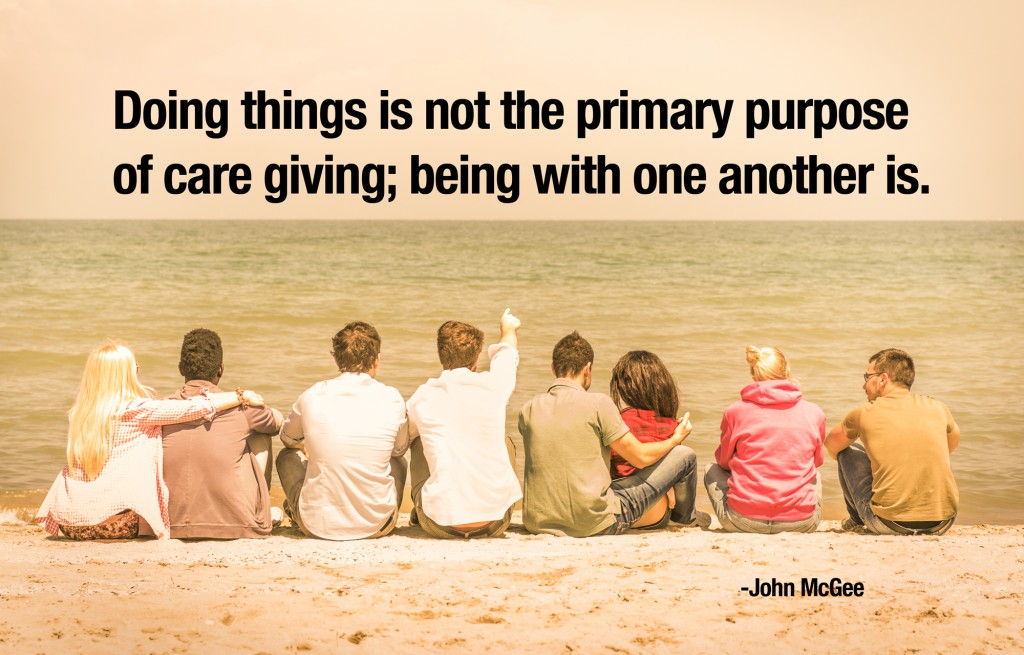
Doing-things-is-not-the-primary-purpose-of-care-giving-being-with-one-another-is

Our pedagogical process starts with us encountering a brokenhearted person and bringing two simple gifts that we have repeatedly mentioned—the feeling of being safe and loved. We have nothing else to give. These are not a program, a clinical approach, or focused on outcomes. They can, if necessary, be translated into mundane outcomes, but, for the caregiver, they are gifts and these now established feelings need to begin to include being safe with a growing circle of others and becoming a meaningful part of increasing engagement.

This stretching process is a part of normal development. These include learning other moral milestones such as learning to share, a giving up, momentarily, of what is theirs; learning to wait and to take turns; wanting others to feel proud; and, learning when enough is enough—self-control. We all have to learn these milestones. Each requires a grounded stance that assumes that the brokenhearted person has learned to feel safe and loved and is ready for participation in a broader community. After these have been formed in the person’s moral memory, we can then begin focusing on strengthening self-esteem, learning that “I am good!” and self-control, learning when enough is enough!” The person’s world and responsibilities begin to expand.

After an intense dimension involved almost solely with unconditional love, it is natural to enter a phase of self-centeredness. It is then that our role evolves into carefully and delicately stretching the still fragile brokenhearted person from a state of self-centeredness to one of other-centeredness. It is a process in which the person learns that it is good to be with a small circle of others, then it is good to do things with this group, and eventually it is good to do things with a wider circle of friends, and finally it is good to do things for others. This last encompasses a high form of moral maturity.

We also begin to focus on the person’s self-esteem. This milestone emerges when others keep reminding the person, “You are so good!” This begins to occur from the very start when we are teaching that it is good to be together. What happens in this process is that the person begins to feel safe and loved from within. As this occurs, the person begins to see him/herself in a different light and forms a moral memory that says, “I am somebody because my caregivers tell me I am.” As the circle of friends grows, the person’s sense of self-worth also expands and becomes stronger.”

– John J. McGee, PhD

Gentle Teaching International Conference 2015

Kansas City, USA welcomes the Gentle Teaching community! On September 9-11, 2015, Kansas City will play host to the 2015 international conference. More information can be found at www.gti2015.com.

Gentle Teaching International 2015 Conference

If you want more information about the 2015 Gentle Teaching International Conference find our events page on Facebook by clicking here.

Teaching Feelings of Safety and Security

“If we want to teach feelings of safety and security, we need to question what we are doing and how we are doing it. The key is to look at ourselves and ask, ‘ What do we represent to the person–love or domination?’ If we see the person as our equal and if we define our relationship as one of brotherhood and sisterhood, then the answer becomes more obvious. We commit ourselves to making certain that our presence signifies feelings of safety and security. Yet, we need to deal with the irony of representing these feelings while face to face with rejection, disruption, or even violence.

Our interactions have to signal warmth, serenity and tolerance.

Our interactions have to signal warmth, serenity and tolerance. From the first instance, we need to make sure that the person interprets our presence as representing nonviolence. Warmth emanates from a strong desire to be one-with-the other. We have to put in check many customary reactions–demands, harshness, and objectivity. Care giving is a very personal process that needs to summon forth feelings of friendship. At first, we should not expect acceptance since all of the person’s history says control is the rule. But, in time, the person will begin to see us as representing safety and security.”


-John McGee

Mentoring a Spirit of Gentleness

“Mentoring is a way to help teach others about gentle care giving, to enter into terrifying spaces and teach others to feel safe and loved.” Mentoring is an approach to do this. It is a way to share with others a spirit of gentleness and justice.

A mentors role is to define the empty and sometimes violent spaces that exist between caregivers and marginalized individuals in institutions, shelters, homes, prisons, nursing homes, schools and wherever we happen to serve. These places have to be filled up with the caregivers’ laces of affection–their loving touch, warm words, and kind gazes. Caregivers need to stop and reflect on the formation of companionship and community and the role of helping individuals feel safe, engaged, loved and loving. From this foundation, caregivers can then create communities of caring. Mentoring is a process for teaching caregivers to establish companionship and community.

Mentoring is a way to teach others

Mentoring is an ever-deepening task that calls for the development of trust among caregivers and the formation of a sense of companionship and community. This trust starts by the Mentor entering into the caregivers’ space with a deep sense of humility and justice and helping each caregiver feel safe and respected. It is the informal coming together of the Mentor and caregiver around the kitchen table and the sharing of the meaning of companionship and community. It is working together and finding ways to teach marginalized people these feelings.”

-John McGee

Psychology of Interdependence

“Regardless of the type of aggression, self-injury or withdrawal, we assume that a hunger for being-with-others rests in the human spirit, longs to be fulfilled, and , in many instances, needs to be uncovered. We struggle to uncover and fulfill this need in ourselves and others. We are often pushed by the fear of giving ourselves to others and pulled by the hope that such feeling give rise to. Our fear can lead us to lord over others in order to gain a false sense of power. But, the more we question our values, our hope can lead us to feelings of companionship. This pushing and pulling leaves us in a quandary–to reach out toward others or to preside over them. The desire to affirm the other is often buried in us by years of training that have taught us that independence is the central goal of life, and, for those who are on the fringes of community, compliance is the pathway to success.

Yet, self-reliance and blind obedience are lonely conditions that lock us and others out of the embrace of human warmth and affection. Those who are committed to care giving often do not recognize this struggle within themselves, let alone in the marginalized people whom they serve, So the first place to start in the psychology of interdependence is with ourselves, our values, and how we translate these into reality.”

John McGee

Authenticating Life

Perhaps you are like me and occasionally enjoy looking at at a piece of art. Whether it is the color, systematic brush strokes and blending or perhaps it is the stylistic nature of the painting. To me art speaks volumes. I love admiring, analyzing and relishing in the beauty of the canvas–for some, admiration isn’t enough.

In 1996, Britain “Ripper” (not Jack the Ripper) emerged from the smoke as the world’s greatest art thief. It was soon found out that the ‘Ripper’ had been a local gardener and golf course keeper whose name was Mr. Bellwood. The first time this man was arrested, the police officers stormed his house to find a typical British dwelling; His wife Susan and their daughter were sitting in their living room having a cup of tea. At first the police feared they had the wrong man as Bellwood’s house had the appearance of being a middle-class home; it wasn’t until they began tearing down Mr. Bellwood’s walls that they found hidden away a gallery consisting of nearly 1,000 pieces of world history and art dating back to the 15th and 16th century. For obvious reasons he was arrested; but was released a mere two and a half years later on having good behavior. Since his release Bellwood has continued his thievery, taking into his possession over one-hundred-million pounds worth of history artifacts and art. It is now suggested that Mr. Bellwood has fled from England and is living overseas and working in the art world.

As soon art began to go missing, duplicates began to appear–however they were falsified documents and had to be authenticated. I don’t know about you, but authenticating something doesn’t sound like and easy job: it takes time, meticulous effort and observation.

When something is authenticated it is deemed, true, genuine, and ‘original to design and purpose’. While some people may heartily disagree with me, I suggest that authenticity in our world is an uncommon trait. Just like Mr. Bellwood, we as people so often portray ourselves as something that we are not or because of our historical pasts, feel unable to live authentically; but this is what our world needs! When you wake up in the morning, and leave your house people should be able to look at your life and be astonished by the courage and boldness that you have to live as you are. This doesn’t mean that we don’t learn from each other: in fact I am convinced that a life that stops learning is a life that stops living — similarly if we can’t live authentically before those who encompass our daily lives, I would ask if we are then truly living.

Authenticity flows beyond ourselves and into our family lives, our relationships and into our places of work. For those who choose to strive to live authentically it fosters a community that births life: a safe place where people are challenged, supported and offered an invitation into true relationship. This needs to become our new status quo. As I sign-off for now I leave you with a snippet from John McGee, who encourages us to live authentically before the people we serve: allowing our own story and personality to penetrate our own hearts and the hearts of those we serve.

“Unconditional love has to be expressed in our very being. Our presence has to evoke a peace like a single glimpse of the sun does in the midst of a storm. Our touch, words, and eyes have to be like a gentle breeze that calms the storm of fear and meaninglessness that is always lingering on the horizon. We must be authentic. How we use these has to reflect our own life-story and personality.” – John McGee

Ben Raine,

Director of Culture and Mentorship

Reverse Effects

“We keep trying to establish feelings of companionship and forming community among those who are marginalized. Yet, we struggle to create a sense of connectedness in a culture that demands independence and self-reliance. We listen to newscasts that announce this. We hear newscasts tell us the strong must control the weak. We read newspaper stories that trumpet the glory of the self. These cultural attitudes become part of our care giving. We have been trained to seek compliance and control. We demand that those whom we serve choose what is right and good when they do not trust us, in fact, often fear us. We live in a world that places the individual above the community.

As care givers, we have to reverse this trend and begin to question what the other needs — to feel safe with us and loved by us. A psychology of interdependence assumes that we find ourselves in others and in the strength of our connectedness to others. It is the foundation of who we are and what we are becoming. It leads us to develop a sense of companionship with those who distance themselves from us. We have to move from a culture of self-reliance to one of human connectedness and from a culture of self to one of otherness. As we do this, we are slowly moving toward the formation of community where we will feel collectively safe, loved, loving and engaged.

Interdependence is based on our shared values — the wholeness and inherent goodness of each person in spite of violent behavior and the thirst that we all have for a feeling of being one-with-one-another in spite of paradoxical behaviors that push others away. These values are difficult to maintain, but are necessary if we are to help those who cling onto the slippery edge of family and community life.”

John McGee,
Mending Broken Hearts: Companionship and Community

COR Presents… Person-Centred Reviews Feb. 24, 2015

Person-Centred-Reviews-COR-Feb-2015