Canada-Saskatchewan Job Grants: Almost Too Good To Be True

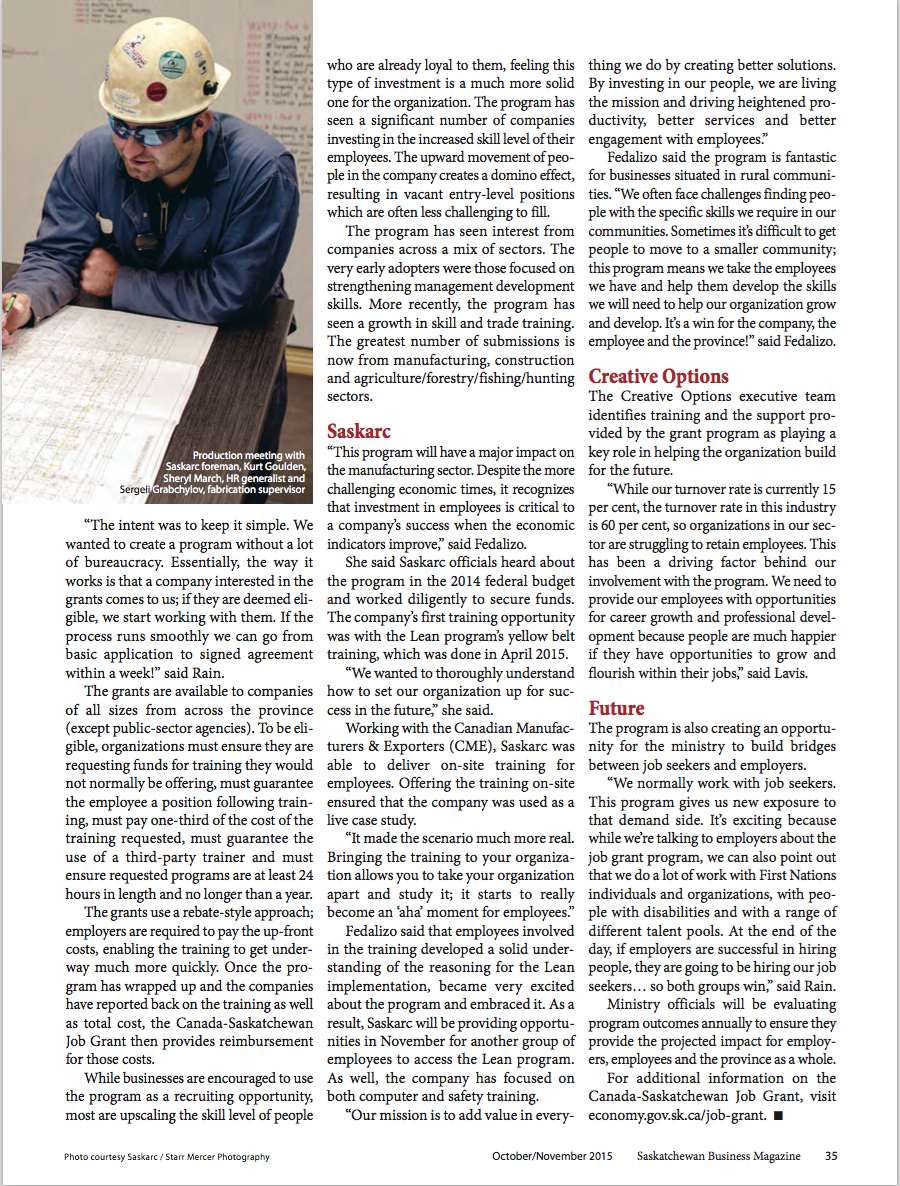
COR was featured in the October/November 2015 issue of the Saskatchewan Business Magazine. Read the article below:

Canada-Saskatchewan Job Grant

Canada-Saskatchewan Job Grant

Canada-Saskatchewan Job Grant

Canada-Saskatchewan Job Grant

Canada-Saskatchewan Job Grant

Canada-Saskatchewan Job Grant

Canada-Saskatchewan Job Grant

Canada-Saskatchewan Job Grant

Onward and Upwards…

In everyone’s life there are those moments or experiences that capture your full attention and enchant your heart. In my life I have had a handful of these experiences: including lying in a rain storm emotionally broken to which when the rain stopped craziest Northern lights began dancing across the skies, my first date with Larissa my beautiful wife and the days that both my children were born.  If you took the time, sat back and reflected on your life I too believe that you would pinpoint experiences that spurred a major reaction within you which kick-started a wave of changes: either big or small. As I sit in this opened aired mall, with people hustling and bustling around with only two weeks before Christmas, I confidently can say that Creative Options Regina (COR) has been added to my life experiences that have provoked change.

Nearly three years ago I took a position with Creative Options Regina after a friend and fellow wait-staff told me about her new position with “this super awesome organization!” The words that flowed from her mouth were captivating and got me excited! Not wanting to sound like a stalked, I hesitantly approached her and asked if she would be ok if I applied with this new-found organization. With a resounding  “YES!” I applied. in the following months, I quit my job as a waiter and engaged in full time support hours with COR. I don’t know if I ever really thanked this person allowed: so now is the time! Thank-you Brittany Bechard for your wisdom in knowing a little about my heart, ‘seeing something in me,’ and  encouraging me to apply. You are an incredible woman and those who you serve and support have a better quality of life because of you. When I first started supporting with COR I served Jesse, Jasen and Shaun. These men are incredible and taught me a lot about myself. Jesse’s determination to do everything in a day, Jasen’s love of authentic relationship and Shaun’s ability to be the slowest eater in the world taught me to embrace the small things, laugh, and rest in the fact that in those moments together nothing else needed to consume me: we were, and that was more than enough. A few short months after starting my journey with COR I was asked if I would consider moving teams to support a young man named Michael. Little did I know that this man would reveal my true colors, challenge me to be a better me, and become not only a friend but a brother.

1380572_10152431665578101_1302041544646813248_n10262049_10152202369193101_8825968592774033917_n10410717_10152466315203101_8085703654700611359_n

My journey with this man was not always easy. Sometimes it was hard. Perhaps it is just me, but I think it is the hard things in life that are worth fighting for. My journey with Michael led me to new heights, literally. In the summer of 2014 we were able to strike out on new adventures together, including a handful of roads trips and an airplane ride around the Regina city limits. Michael, and others in COR have become an intricate part of our family: coming over for meals, playing with our kids and engaging in this “thing” we call life. My words can’t express the joy and appreciation I have for each of the people who have come into my life during this time of my life.

10559809_10152382915853101_6438454310541075323_n

250277_10152574840868101_3030308607101654052_n

10590549_10152384736463101_4252474471381092863_n  1912451_10152801791528101_7228477045715026966_n  12047178_10153416605163101_3018268801905407118_n

Though the people that I have been led to serve have impacted me tremendously: I have been equally left effected by those who I am blessed to call friends and coworkers. From the leadership of the management team, to the bravery of team leaders, to the humility of support people, you have sparked change in my life: Whether it is Jenna walking into my office to “just talk about life”, or going out for a drink with Ryan, Reid, Murray or Bart to talk about the philosophical structures of Gentle Teaching, I have been challenged and changed: Thank-you.

Perhaps this is why it is so difficult to write this blog: the relationships we have built matter! It is with a mixing pot of emotions that I write to tell you that as a family we have decided to resign from my position as Director of Culture and Mentorship and relocate. Our decision was one that was not taken lightly, or easily made. Every square inch of the effect of our decision was scrutinized and processed: to the point of believing that I needed a heart transplant.  It is with great sadness that we let everyone know that as of January 15th, 2016 we will no longer be serving at Creative Options Regina. This decision had little to do with COR and more with my own physical health, the health of our family and an opportunity that we believe will lead us to help spark change elsewhere in Saskatchewan.

As we prepare to leave there are a lot of details that we are hoping and praying will fall into place. But I am fighting hard to finish well. I believe that whatever my hand finds to do I have a role and a responsibility in helping it come to fruition: to pursue the best outcome possible. In the coming weeks, I will be focusing a lot of my time to the curriculum that I have been developing over the past year, along with finding moments to say those proper goodbyes.

If I may: and I will! I would like to leave you with a message of encouragement. It has often been said that Gentle Teaching carries a lot of power. While I don’t disagree with this completely, I believe that it can be refined all the more. Gentle Teaching equips people with the skills and tools to have a voice of influence, which in return equips you with a “power”. Now don’t misunderstand me: I am not suggesting that you are to have power OVER someone. Rather, you, yes YOU, have the ability to be a powerful influence. The way in which you choose to interact with someone, and the words that you use can and will change a person’s life. So I beg you: be kind, speak with wisdom, pursue good, love the lonely, hurting and brokenhearted, know that your purpose on this earth goes beyond the material things that we we can collect for ourselves. The relationships in which you currently find yourself (whether long-lasting or temporary) are the most meaningful. As you go through out your daily life, with friends, loved ones and team members, remember your tools. Your mouth is to speak kind words, uplifting others. When your hand is forced to address difficult situations remember that your words carry a powerful punch and even in the midst of addressing conflict or correction can become vessels of empowerment for those you are speaking to. Your hands are to be agents of care: assisting the homeless, uplifting the broken, encouraging the fearful yet doing all of this together. Your presence should display the message of your intent: I am here with you, through thick and thin. As I often have said my training’s, “we are in this together, because WE, well we are the dream team and nothing can stop us!” And finally use your eyes to empathize, sympathize and see the true story of peoples lives.  Our eyes should not just be used for the present, but be used for the future. Dream big dreams for both yourself and the person you are serving. Work hard not to become entrapped in what you see now, but dream about tomorrow. The people you serve deserve it, and so do you!

From my family to you: we thank-you for the impact that you have had in our lives.

With all of my heart and deepest gratitude,

Ben Raine


Studying the sexual barriers faced by people with disabilities

Check out this intriguing article featuring the research of Michelle Apps, MSW Candidate at the University of Regina. COR is proud to be supporting Michelle in her academic journey!

Article by: Dale Johnson, posted to the UofR website on December 3, 2015

______________________________

A University of Regina student is looking into how disabilities affect a person’s sex life.

“I’m conducting research in this area, because it’s often viewed in society as a very taboo subject. It’s important to have conversations with folks experiencing disabilities to see what their experiences are accessing sex, and how they think it could be better facilitated,” explains Michelle Apps, who is conducting the research project as part of her Master of Social Work program. “It’s a very under-researched area, in both disability studies and sexuality studies, so through the intersection of the two I hope to bring a bit more attention to the subject.”

“I’m hoping my research will lead to people with disabilities feeling as if they have a voice in this area and are being heard. I’m hoping to add to the small but growing body of literature supporting people with disabilities accessing sex as a right, and to help dispel the myth that people with disabilities are asexual beings,” she says.

Her faculty supervisor, Dr. Randy Johner, says: “Although many people with disabilities, and those who support people with disabilities, believe that accessing an erotic life is very important and needs to be openly discussed in both private and public spheres, there is a great reluctance to share such sensitive and sometimes very hurtful issues concerning sexuality with someone outside of one’s care circle.”

Apps’ research is supported by Creative Options Regina, an organization that supports people with developmental disabilities through housing and programming.

“They have been instrumental in helping me get in touch with potential research participants, and I’m assisting them with some policy and programming development,” she says.

Apps is looking for people with disabilities, physical or intellectual, to share their experiences with her about accessing an erotic life (defined as any sexually-charged touch and can include cuddling, hugging, kissing on so on), what barriers they have faced, and how they think it could be best facilitated.

“I am hoping to have initial results before Christmas, or early in the New Year. I am aiming to submit my findings to the Review of Disability Studies in the spring,” she adds. “I am hoping that through knowledge translation through publishing and presenting at conferences, that I can help support policy changes at higher levels.”

Click here for the full article on the UofR website.

Click here for the Regina LeaderPost Article: University of Regina student researching sex for the disabled

Click here for the Global Regina Story: People with disabilities still want sex, according to U of R research


Dispelling Myths About People with Disabilities

COR partnered with four AWESOME UofR Kin Students on a project for the International Day for Persons With Disabilities (IDPD 2015). Check out this great story about the project posted to the UofR webpage on December 2, 2015. Be sure to watch the video too!!

Article by: Costa Maragos

________________________________________

Some myths and misconceptions about people with disabilities are being explored in a compelling and thoughtful video produced by four Kinesiology students.

The video production is titled; Inclusion Matters: Debunking Common Myths Around Disability.

“We hope to generate some critical thinking and open-ended discussions about the current myths and stereotypes many people have about people with disabilities,” says Jordan Wirachowsky, one of four students involved in the production. “The overall message is we hope it can change  attitudes towards people with disabilities and create a more inclusive society.”

Wirachowsky, along with Matthew Pacholko, Jason Mo and Jordan Wyonzek, came up with the idea as part of a project in their Kinesiology 342 class, Developmental Disabilities & Well-Being, taught by professor Brenda Rossow-Kimball.

The video has been produced to coincide with International Day of Persons With Disabilities, December 3. That day, the video will be shown to a class at Campbell Collegiate in Regina.

In the video, students, faculty and staff on campus are asked to respond, sometimes with little or no warning, to various statements relating to myths about people with disabilities, including:

  • people with disabilities only like to spend time with others who have disabilities;
  • people with disabilities are more likely to be injured in the workplace;
  • people with disabilities are not independent and are unable to perform tasks of daily living.

“A few individuals gave some real thought to the questions and strived to dig deeper and find true meaning in the questions,” says Pacholko. “Some students appeared at a loss of explanation. Perhaps it was because they’ve never thought of the topic in such a way before or because they were put on the spot.”

Watch Inclusion Matters: Debunking Common Myths Around Disability, produced jointly by Brandon Wu of Strategy Lab and Creative Options Regina.

As part of the assignment, the students were asked to connect with a community organization and create a project that recognizes this year’s theme for International Day of Persons With Disabilities.

The students connected with Creative Options Regina, a non-profit organization in Regina that develops personalized support services for people with disability.

“Participating in class projects such as this helps raise awareness of our organization, while further contributing to the development of a more inclusive community for all,” says Michael Lavis, Executive Director of Creative Options Regina.

The video’s overall message, say the students, is the hope it can change peoples’ attitudes towards those with disabilities and create a more inclusive society.

“A more inclusive society helps build relationships and allows people with different abilities to be valued and shown dignity,” says Pacholko.


Click here for the full story on the UofR webpage.


Gentle Teaching Theme for December 2015: Servant Leadership


Servant LeadershipServant Leadership - 2


The Al McGuire Award Winner for Transition to Employment 2015 – Patrick Flaman

Creative Options Regina (COR) is very happy to annouce that our very own Patrick Flaman is the winner of the Al McGuire Award for Transition to Employment 2015. His work ethic and attitude are like no one else, Patrick is an exemplary employee and just an all around great guy. We’re proud to have Patrick a part of the COR family.

Patrick Flaman-Al mcguire Award winner

Health and Wellness Theme for November: Rest & Relaxation

Rest and RelaxationRest & Relaxation - 2

Hands-on approach made a world of difference

Hands-on approach made a world of difference | Video

Tara Schmiedge curls up on a pile of fluffy white pillows, swinging on a circular bed suspended like a cloud from the ceiling of her basement living quarters.

Her mom, Margot, crawls in next to her, iPad in hand, to look through family photos. Childhood scenes of Tara and her three sisters quickly transition to a newborn baby, pink and swaddled — Tara is now an aunt, and Margot a grandmother. The two laugh as they sway gently back and forth, two peas in a floating pod.

Tara, 25, has Kabuki Syndrome, a relatively rare genetic disorder that causes cognitive delays, behavioural issues and a wide range of medical problems.

These days, Tara is at ease in her world. She shares a northwest Regina home with another young woman with a disability and the support workers who come and go around the clock. She has a specially designed, one-on-one day program that meets her needs. Her parents, Margot and Dean, visit regularly and make sure her life is full of love and encouragement. They have fought tirelessly to make sure she has adequate support to do the best she can with her abilities.

*****

As most families with a disabled child find out, it’s never easy.

The Schmiedges started taking Tara to Winnipeg for sensory therapies as a preschooler, before she was diagnosed. They knew she had cognitive delays, something they could see when comparing Tara’s development to that of her two older sisters, Leah and Kyla, and younger sister Erica.

Doctors originally thought Tara might have osteogenesis imperfecta, since Margot had a family member with the congenital bone disorder.

“We knew that wasn’t likely the right syndrome,” Margot said, noting Tara’s cognitive delays didn’t fit that diagnosis.

Then Tara was diagnosed with Kabuki Syndrome by a Winnipeg geneticist at four-and-a-half years old. It was a relatively newly-categorized disease, first described in 1981 by Japanese scientists.

“Having a child with a disability can really make you feel like an island,” Margot said, tucked into a comfortable chair in her home a few minutes’ drive from Tara.

“You try to maintain your friendships from before, and you do, but your life goes in a whole different direction than the majority of people.”

It was that isolation that encouraged Margot to pen a letter in a medical genetics journal about a year after Tara was diagnosed.

Using a family friend’s then-advanced method of communication — an email address — she was soon inundated with requests to keep in touch and share information about Tara’s development and challenges. They quickly had to invest in a computer and a dial-up Internet connection of their own.

A website was also necessary. But in the mid-1990s, it wasn’t quite as easy as it is today to post things to the mysterious world wide web.

Margot enlisted the help of her brother, Ed Zwart, and his partner Janice Banser. The two technophiles made Margot’s dream for a network where families could connect and share information a reality.

And so the Kabuki Syndrome Network (KSN) was born. If you search Google for Kabuki Syndrome today, it is still the top hit.

Over the past two decades, Margot has fielded thousands of requests for information in multiple languages from her home. Some were from researchers; other requests were from families unsure of where to turn with their new diagnosis.

Her background as a nurse — she stopped working when Tara was born — helped in explaining the complicated terms to other parents, including writing a medical dictionary.

Newsletters were the next step. They were printed and mailed out for years, before moving to an online format. Brochures came out in several languages — Margot got a language school to translate portions of the website into Spanish to meet demand. She even reached out to geneticists and doctors to write articles that the average parent could understand.

“Little things like that started adding up to provide a bigger source of information,” Margot said. “It’s funny how things snowballed. I never set out to do this, never.”

From supporting newly-diagnosed families reaching out for help to assisting doctors looking to explain the disorder in layman’s terms, the quiet force behind a mountain of information has been passionately advocating not only what’s best for Tara, but what works for other children around the world with the condition.

“She’s really an amazing, one-woman magician,” said Dana Levinson, a Minnesota mom of a seven-year-old girl who also has Kabuki Syndrome.

When Levinson’s daughter was diagnosed as an infant in 2008, she soon found there wasn’t much local support for a syndrome with an incidence rate somewhere around 1 in 10,000. Reaching out to Margot and the KSN was a major step in learning how to live with the diagnosis.

“Kabuki was first discovered in the 1980s and really since then (Margot)’s been the main person providing info, identifying professionals, connecting families,” Levinson said.

Levinson not only wanted to learn more about the syndrome but also become involved in helping shape what the KSN could become. She’s leading the organization’s efforts for the first-ever Kabuki Syndrome conference, which will take place at Johns Hopkins University in Baltimore this summer.

Meeting other families who have a child with Kabuki Syndrome has been “so helpful”, Levinson added.

“These are kids that tend to have developmental issues. My daughter wears hearing aids and she had a feeding tube, so just meeting other kids that may have had similar experiences is good for her for having a social support group, too.”

KSN has been a support for the Schmiedges too, leading to long-term friendships and visits while vacationing, but it didn’t always hold the answers to every problem.

“Tara is definitely on the higher end of physical disability and sensory issues and because of that she had many, many behavioural issues from about 13 on,” Margot said.

It was something that the family had to face mostly on their own. Their lives got “very complicated.”

In some instances, Tara would hit and bite. Her obsessive tendencies and anxieties were a part of daily life.

On a family camping trip, Margot brought along Tara’s favourite cookies — a huge motivator for Tara at the time — but she wouldn’t eat them. She barely touched food the whole weekend.

“We get back home and we’re unpacking the food, and she brings her cookies to the cupboard where the cookies go. She sits down, goes back to the cupboard, takes the cookies out, and starts eating,” Margot said. “Those cookies had to come out of that cupboard.”

School also became too much for her. Tara stayed in high school until 22, but was only managing a couple of hours per day by her last year.

Judy Humphries, Tara’s former student support services teacher at Michael A. Riffel High School, said the system can be hard to navigate for parents who aren’t sure what their options are for their child’s post-high school life.

“The transition is difficult sometimes for the students themselves, because they’ve been at their particular school for up to eight years, some of them. It’s hard to leave,” she said.

For students like Tara, the existing day programs may not be the right fit.

“There were things that Tara’s parents knew would not work for her,” Humphries said. “They could’ve just thrown up their hands and said ‘We give up, wherever she ends up will be fine,’ but that’s not what they did.”

Instead, Margot designed a day program for Tara that comes with one-on-one support. She does various tasks during the day, from collecting recyclables to delivering Meals on Wheels. In summer, she likes watering community gardens.

It’s a different path than some other young adults with disabilities take, and one that required letter-writing and many meetings.

“I’m a bit of a doer myself, it’s in my nature. We had to really fight to get her what she needed,” Margot said.

“All young people with cognitive disabilities should have those kind of parents,” Humphries added. “They need someone that’s just looking out for them.”

*****

Tara was finally designated as “complex needs” — a designation not given lightly.

It means Tara has access to special funding for her housing and day program.

The Schmiedges’ advocacy work for their daughter is far from done. Her home had three other young women with disabilities when she first moved in and Tara had daily meltdowns over the pressures of living away from her parents and the constant stream of visitors and staff.

“It was very, very difficult for Tara,” Margot said. “We tried to prepare her. We’d go to the house before anyone was living there, show her where her bedroom would be.”

But it didn’t sink in, and the first year was terrible.

Daily panicked phone calls begging to come home were hard to face.

But it was an important step for not only Tara to make, but for her parents, as they too needed to have some space. And once two of the residents were moved to a new home, it became a lot easier.

“I like that we get to enjoy her now. I really like that. It’s not that we never enjoyed her, but I really just enjoy her now.”

Tara is doing “amazing” these days, she added.

“She’s a sweetheart, an absolute sweetheart. Everybody that gets to know Tara falls in love with her. She has challenging behaviours but once you know how to go around that, she’s really very endearing and so truthful.”

The efforts they’ve put in over the years have not only improved their own lives, but those of many other families with Kabuki Syndrome. Yet, Margot doesn’t think they’ve done anything extra special.

“There are parents that believe that it takes special parents to raise a child with special needs, but I don’t share this philosophy,” she said.

“I think you have a choice to make when you have a child with special needs. You either work very hard at it, or you drown in the immensity of it. And I think Tara taught us the patience.”

_____________________________________________

What is Kabuki Syndrome?

— First described in 1981 by Japanese scientists and named after affected individuals’ facial resemblance to traditional Kabuki makeup

— Affects anywhere from 1 in 10,000 to 1 in 30,000 live births

— Caused by spontaneous gene mutation in one of two genes

— Wide range of congenital problems can result, from heart defects to kidney issues to recurrent ear infections

— Also a wide range of cognitive and intellectual disabilities, from mild learning disabilities to autism-like symptoms

— No known impact on lifespan, although the syndrome has only been described for 34 years

— Research continues into the genes causing Kabuki Syndrome. A recent study by Johns Hopkins researchers in mice with a genetic change similar to Kabuki Syndrome reports that the use of an anticancer drug can “open up” DNA, leading to improved mental function


Regina Leader-Post Article, by: Rachel Psutka

Published on: October 15, 2015 | Last Updated: October 15, 2015

Download the Regina Leader-Post article here.