Posts

Teaching Feelings of Safety and Security

“If we want to teach feelings of safety and security, we need to question what we are doing and how we are doing it. The key is to look at ourselves and ask, ‘ What do we represent to the person–love or domination?’ If we see the person as our equal and if we define our relationship as one of brotherhood and sisterhood, then the answer becomes more obvious. We commit ourselves to making certain that our presence signifies feelings of safety and security. Yet, we need to deal with the irony of representing these feelings while face to face with rejection, disruption, or even violence.
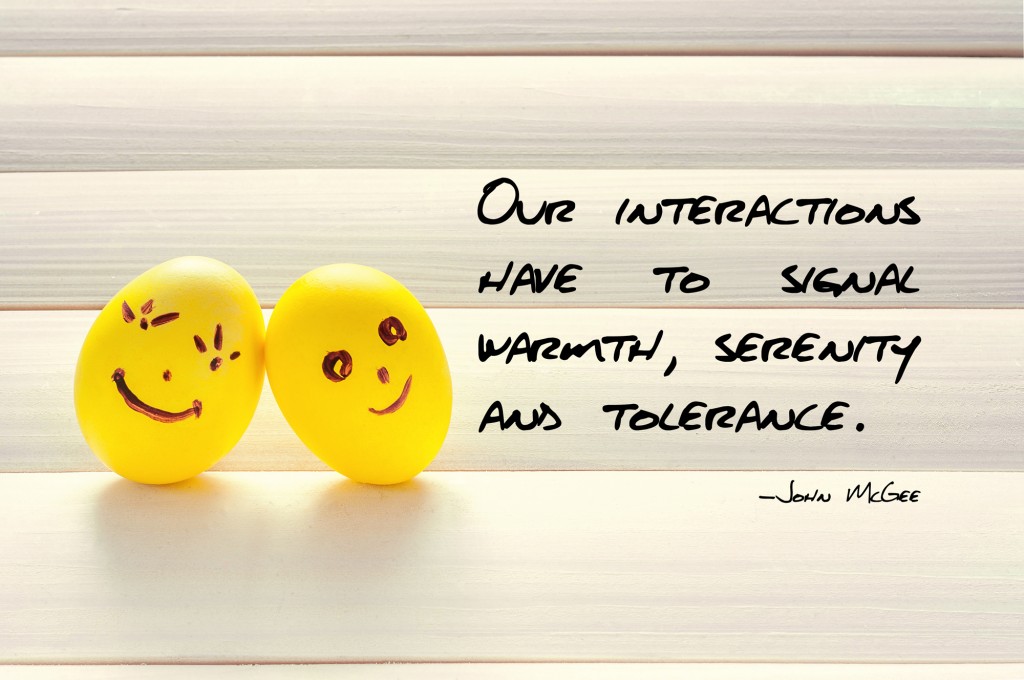
Our interactions have to signal warmth, serenity and tolerance.

Our interactions have to signal warmth, serenity and tolerance. From the first instance, we need to make sure that the person interprets our presence as representing nonviolence. Warmth emanates from a strong desire to be one-with-the other. We have to put in check many customary reactions–demands, harshness, and objectivity. Care giving is a very personal process that needs to summon forth feelings of friendship. At first, we should not expect acceptance since all of the person’s history says control is the rule. But, in time, the person will begin to see us as representing safety and security.”


-John McGee

Our Approach is Based on Moral Development

“Our approach is based on moral development. This is not a church thing. It is an internal feeling that we develop over time about what is good, who we are, and why we are on this earth. It is an inner change, a change of the heart. It is what most children learn early in their life about feeling safe and loved. It is what many of us have to re-learn when we are crushed by life’s sorrows.

So, we have to develop an understanding of basic moral values and teach these in an authoritative manner, not coming down on the person, but patiently and repeatedly teaching them. Morality is the way we feel and view our role in life. It is made up of our basic beliefs that are learned through our own life-experiences and ongoing reflection on our place in the world. It is formed deep down in our memories over time and with many experiences. Morality is on the fringe of our consciousness. We often do not have to stop and think, “Should I do this or not do that?” Our life-decisions come out of deep, deep memories. A spirit of gentleness focuses on teaching deep moral memories to people whose hearts are broken. Our primary strategy is repeated acts of love.

The first moral rule is found in a feeling of companionship– safe, loved, loving, and engaged. We know, without even thinking about it, that we need to feel safe and loved on this earth. We gravitate toward those who fulfill this sense and move away from those who make us fearful. Yet, many people whom we support are filled with fear of themselves and of others. We look for meaning in our lives and find it in our relationships with others other family, our children, our friends. Many whom we serve do not have this type of meaning.

The second is found in community– the goodness of being with others, engagement with others, and reaching out to others, and a sense of connectedness with others. It is a feeling of being collectively safe, loved, loving, and engaged. It moves from a singular relationship with the caregiver to a collective relationship with a circle of friends.

Companionship and community occur in a spiral. The initial relationship is at the center, but slowly spins outward to others. Everyone needs the feeling of being safe and loved to also feel loving and engaged. This evolves with one person, then two, then many.”


-John McGee, ‘Mending Broken Hearts’

Psychology of Interdependence

“Regardless of the type of aggression, self-injury or withdrawal, we assume that a hunger for being-with-others rests in the human spirit, longs to be fulfilled, and , in many instances, needs to be uncovered. We struggle to uncover and fulfill this need in ourselves and others. We are often pushed by the fear of giving ourselves to others and pulled by the hope that such feeling give rise to. Our fear can lead us to lord over others in order to gain a false sense of power. But, the more we question our values, our hope can lead us to feelings of companionship. This pushing and pulling leaves us in a quandary–to reach out toward others or to preside over them. The desire to affirm the other is often buried in us by years of training that have taught us that independence is the central goal of life, and, for those who are on the fringes of community, compliance is the pathway to success.

Yet, self-reliance and blind obedience are lonely conditions that lock us and others out of the embrace of human warmth and affection. Those who are committed to care giving often do not recognize this struggle within themselves, let alone in the marginalized people whom they serve, So the first place to start in the psychology of interdependence is with ourselves, our values, and how we translate these into reality.”

John McGee

I absolutely love the people I support at COR

“First, I must say that I absolutely love the people at COR. There is never a day that I dread–and I believe that is a bold statement; especially when rough days arise. I really do care about the well-being of these individuals and I believe the strong relationships I have built reflect this. Secondly, I feel that my honesty and enthusiasm makes others feel safe and loved; and others are able to open up to me. I want to treat everyone the same and not talk down to anyone. I consciously practice what I preach and always strive to be fair in both decision making and everyday conversations.”

Whitney, COR Support

Brian Calley’s Remarks at the 2014 Culture of Gentleness Conference

An inspiring speech by Lieutenant Governor Brian Calley given during the 2014 COG Conference in Michigan, USA.

A culture of gentleness is also about being able to be vulnerable

“When I first heard about creating a culture of gentleness I had no idea what that meant.

After going to trainings, learning about gentle teaching, and seeing a culture of gentleness through the people around me in an organization that seemed so alien, I finally understood what it was. Talking about a culture of gentleness isn’t enough. You don’t really understand what it is until you start partaking in the movement of gentleness that has spread across Canada. It really is a powerful thing.

I learned that creating a culture of gentleness doesn’t just mean serving the people that we support, but serving every person you meet on the street and at home.

It is a way of life. I had to change my mind set and mold my thinking to something completely different and something unnatural to a lot of people. Growing up the way I did, I learned what it meant to love unconditionally and to care for people in a way that was personal. Maintaining a culture of gentleness is very personal. In order to have gentleness, I needed to care about another person more than myself and take their limitations and physical or mental state away from how I viewed them. I have come to do this everyday with the people I support. I see them more than just someone I look out for and someone I spend a lot of time with: I see them as friends and as a huge part of my life, because to them sometimes you are their family.

The way I create a culture of gentleness is finding a balance between being firm and being personal with each person I serve. The definition of gentle is to be kind and mild temperament; I have found that being that understanding person that will listen and care in a more personal way has created this culture of gentleness for our team. The more bonded we are on a personal level and the more we listen and show kindness to each other the more gentleness has spread.

In my team, I have had to hold team members accountable and have had to have some tough conversations, but at the same time, building each person  up and showing them that I care for them. In order to create a culture of gentleness, I needed to gain trust. In going out of my way to make team members feel comfortable with me, I demonstrated that I genuinely care for them and their life situations. I try and make the people that I serve feel appreciated and loved, I have written personal cards to each and every one of them praising them for things that I have seen them do well. To maintain a culture of gentleness, I have realized that taking the times is very important… A culture of gentleness is also about being able to be vulnerable with both the people that we support and those who we serve with. It has helped us grow individually, as well as grow as one.”

A-culture-of-gentleness-is-more-than...

Krystel, Team Leader

It Is Important To Listen

“For creating and maintaining a culture of gentleness with the guys I support it is important to listen to what they have to say, help the guys to feel safe and loved; and to be engaged. The way I do this is that when they are talking I make sure I am looking at them and responding to them even if I already know or have heard what they are telling me. Also, when they are upset or angry, I attempt to give them their space until they are ready to talk about what was upsetting them. I never get mad or yell!

Some of the ways that I make the guys feel safe is by telling them that I am here for them and that I am not going to let anything happen to them. Some of the ways that I show the guys love is by taking them to a place they love or by watching a show or a movie over and over just because it makes them happy. Another way I show that they are important and loved is that even when I am not supporting I will still come to hangout, answer calls or texts and play games. The main way that I help the guys feel loved is by telling them that they are smart, good and that I love them: I will also give hugs freely.

The way I get the guys feeling engaged is by taking them to my house and meeting my family; by engaging them to help me personally, or with tasks that need to be done around their houses. In creating and maintaining a culture of gentleness with supports, I try to be as helpful as I can by being flexible with open support times. Also instead of getting upset or questioning an issue, I either ask questions or talk to someone, like my team leader.”

Jenna, COR Support

COR is Such a Perfect Fit For Me!

“I have always been a very sensitive person, which allows me to feel compassion and empathize with those around me. This is why I believe that COR is such a perfect fit for me! By reading the website and from my first experience shadowing as a support, I instantly knew I was extremely lucky to be hanging around such amazing, strong people.

I have always been drawn to people with disabilities as I find a deepened sense of honesty and a genuine spirit: there is no fear to be themselves, which is something I fully admire. I do my best to involve the guys I support within the community, but I am grandstanding when they are hesitant as the majority of them have had their fair share of struggles in life. I am very much attached to the men that I support and consider them very good friends. I don’t believe I could have formed the type of relationship I have with them if I were to use any philosophy over Gentle Teaching. I believe that Gentle Teaching, equips people to listen, to act in love and to be diligent in selflessness. I believe that Gentle Teaching comes natural to me, as I am a very gentle soul, and although there are tough times when the guys are going through difficulties and sometimes it may be hard to remain clam, Gentle Teaching always prevails and makes me realize that there are reasons for their struggles and my role as a support, and a friend is to help: not to alter behaviour in any form of condescendence or discrimination.”

Marie-Claire, COR Support

Empowering a Spirit of Gentleness

A Spirit of Gentleness is About…

Our nonviolence
• Our sense of social justice
• Our expression of unconditional love
• Our warmth toward those who are cold
• Our teaching others to feel safe, loved, loving, and engaged
• Our teaching a feeling of companionship with the most marginalized
• Our forming community
• Our sense of human interdependence and solidarity
• Our option to be side by side with the most devalued

A spirit of gentleness might seem easy; but, always remember, we do things that many can interpret as cold and controlling, often without even realizing it. The cold space that exists between us and the vulnerable person deepens and broadens without us even realizing it when we focus on control with a “Do this or else!” mentality or when we wallow in hopelessness with an attitude of “Well, that is just the way she is.”

Without even realizing it, our tone of voice, our posture, the way we look at someone, and the way we talk can tell the vulnerable person strong messages that say, “You are no good! Do what I tell you to do or else!” We do not do this intentionally. Yet, if we do not understand human vulnerability and fragility, our simplest actions can take on a horrendous meaning. Our priorities are often messed up if we focus on behaviors instead of feelings or independence instead of interdependence. We need to worry about helping each person begin to feel more safe and loved instead of getting rid of behaviors.

John McGee
“Mending Broken Hearts: Companionship and Companionship”

Our hope is…

“As care givers, we need to be well grounded. Our hope is not in independence, but interdependence. Our primary task is not to control others or force others to be what we want them to be or do what we want them to do. It is to bring a deep unconditional love to those whom we serve. Our central purpose is not self-determination or self-reliance; it is a feeling of connectedness between those whom we serve and ourselves. Our central role is to express a profound sense of companionship and community. What we often think are our primary tasks will come in due course if those whom we serve feel safe, loved, loving and engaged.

We are community makers. Community is a gathering of gifts. Our gift in the act of care giving is the creation of companionship and the formation of community. Those whom we serve bring their mind-body-spirit, their dreams denied, and their hunger for love. They bring their troubles and sorrows, their life story, and their broken hearts. We are to bring a spirit of gentleness to mend their hearts.”

John McGee
‘Mending Broken Hearts: Companionship and Community’