Authenticating Life

Perhaps you are like me and occasionally enjoy looking at at a piece of art. Whether it is the color, systematic brush strokes and blending or perhaps it is the stylistic nature of the painting. To me art speaks volumes. I love admiring, analyzing and relishing in the beauty of the canvas–for some, admiration isn’t enough.

In 1996, Britain “Ripper” (not Jack the Ripper) emerged from the smoke as the world’s greatest art thief. It was soon found out that the ‘Ripper’ had been a local gardener and golf course keeper whose name was Mr. Bellwood. The first time this man was arrested, the police officers stormed his house to find a typical British dwelling; His wife Susan and their daughter were sitting in their living room having a cup of tea. At first the police feared they had the wrong man as Bellwood’s house had the appearance of being a middle-class home; it wasn’t until they began tearing down Mr. Bellwood’s walls that they found hidden away a gallery consisting of nearly 1,000 pieces of world history and art dating back to the 15th and 16th century. For obvious reasons he was arrested; but was released a mere two and a half years later on having good behavior. Since his release Bellwood has continued his thievery, taking into his possession over one-hundred-million pounds worth of history artifacts and art. It is now suggested that Mr. Bellwood has fled from England and is living overseas and working in the art world.

As soon art began to go missing, duplicates began to appear–however they were falsified documents and had to be authenticated. I don’t know about you, but authenticating something doesn’t sound like and easy job: it takes time, meticulous effort and observation.

When something is authenticated it is deemed, true, genuine, and ‘original to design and purpose’. While some people may heartily disagree with me, I suggest that authenticity in our world is an uncommon trait. Just like Mr. Bellwood, we as people so often portray ourselves as something that we are not or because of our historical pasts, feel unable to live authentically; but this is what our world needs! When you wake up in the morning, and leave your house people should be able to look at your life and be astonished by the courage and boldness that you have to live as you are. This doesn’t mean that we don’t learn from each other: in fact I am convinced that a life that stops learning is a life that stops living — similarly if we can’t live authentically before those who encompass our daily lives, I would ask if we are then truly living.

Authenticity flows beyond ourselves and into our family lives, our relationships and into our places of work. For those who choose to strive to live authentically it fosters a community that births life: a safe place where people are challenged, supported and offered an invitation into true relationship. This needs to become our new status quo. As I sign-off for now I leave you with a snippet from John McGee, who encourages us to live authentically before the people we serve: allowing our own story and personality to penetrate our own hearts and the hearts of those we serve.

“Unconditional love has to be expressed in our very being. Our presence has to evoke a peace like a single glimpse of the sun does in the midst of a storm. Our touch, words, and eyes have to be like a gentle breeze that calms the storm of fear and meaninglessness that is always lingering on the horizon. We must be authentic. How we use these has to reflect our own life-story and personality.” – John McGee

Ben Raine,

Director of Culture and Mentorship

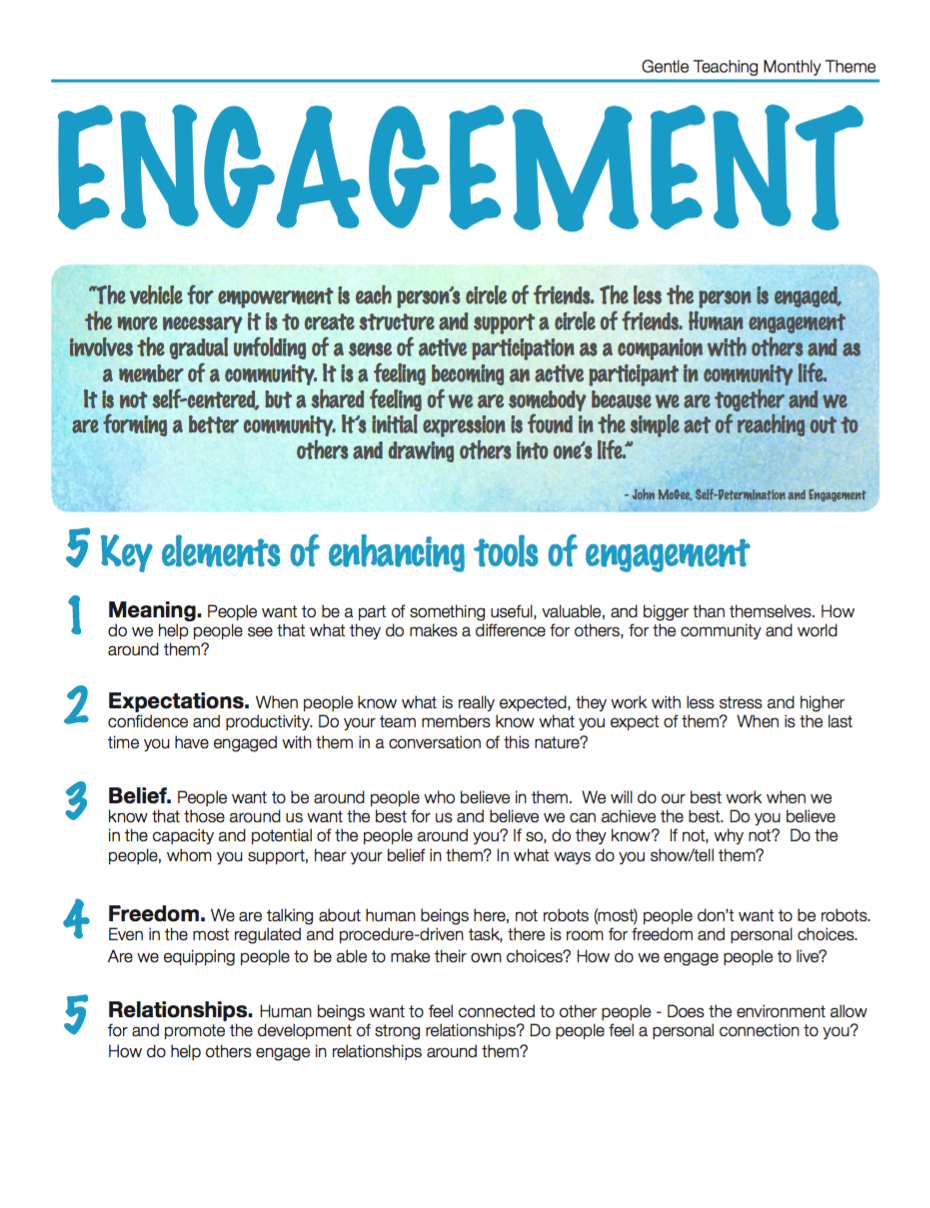
Gentle Teaching Theme for March 2015: Engagement

EngagementEngagement - 2

Reverse Effects

“We keep trying to establish feelings of companionship and forming community among those who are marginalized. Yet, we struggle to create a sense of connectedness in a culture that demands independence and self-reliance. We listen to newscasts that announce this. We hear newscasts tell us the strong must control the weak. We read newspaper stories that trumpet the glory of the self. These cultural attitudes become part of our care giving. We have been trained to seek compliance and control. We demand that those whom we serve choose what is right and good when they do not trust us, in fact, often fear us. We live in a world that places the individual above the community.

As care givers, we have to reverse this trend and begin to question what the other needs — to feel safe with us and loved by us. A psychology of interdependence assumes that we find ourselves in others and in the strength of our connectedness to others. It is the foundation of who we are and what we are becoming. It leads us to develop a sense of companionship with those who distance themselves from us. We have to move from a culture of self-reliance to one of human connectedness and from a culture of self to one of otherness. As we do this, we are slowly moving toward the formation of community where we will feel collectively safe, loved, loving and engaged.

Interdependence is based on our shared values — the wholeness and inherent goodness of each person in spite of violent behavior and the thirst that we all have for a feeling of being one-with-one-another in spite of paradoxical behaviors that push others away. These values are difficult to maintain, but are necessary if we are to help those who cling onto the slippery edge of family and community life.”

John McGee,
Mending Broken Hearts: Companionship and Community

4to40 featured in Saskatchewan Chamber of Commerce Newsletter

Well 4to40 is at it again! This time it was the Saskatchewan Chamber of Commerce writing about the impact the program is having at the University.

University of Regina Supports students with disabilities 4to40 making a dent in Saskatchewan

To download the Saskatchewan Chamber Newsletter, click here –> Jan 2015 Edition

Finding Value in My Day – March 4th & 5th, 2015

Finding Value in One's Day Poster - March 2015


COR is pleased to we welcoming the return of Cara Milne to Regina to host two, one-day workshops on Finding Value in My Day! For more information, contact the COR office.

I absolutely love the people I support at COR

“First, I must say that I absolutely love the people at COR. There is never a day that I dread–and I believe that is a bold statement; especially when rough days arise. I really do care about the well-being of these individuals and I believe the strong relationships I have built reflect this. Secondly, I feel that my honesty and enthusiasm makes others feel safe and loved; and others are able to open up to me. I want to treat everyone the same and not talk down to anyone. I consciously practice what I preach and always strive to be fair in both decision making and everyday conversations.”

Whitney, COR Support

Gentle Teaching Theme for February 2015: Language

LanguageLanguage - 2

COR Presents… Person-Centred Reviews Feb. 24, 2015

Person-Centred-Reviews-COR-Feb-2015

Brian Calley’s Remarks at the 2014 Culture of Gentleness Conference

An inspiring speech by Lieutenant Governor Brian Calley given during the 2014 COG Conference in Michigan, USA.

A culture of gentleness is also about being able to be vulnerable

“When I first heard about creating a culture of gentleness I had no idea what that meant.

After going to trainings, learning about gentle teaching, and seeing a culture of gentleness through the people around me in an organization that seemed so alien, I finally understood what it was. Talking about a culture of gentleness isn’t enough. You don’t really understand what it is until you start partaking in the movement of gentleness that has spread across Canada. It really is a powerful thing.

I learned that creating a culture of gentleness doesn’t just mean serving the people that we support, but serving every person you meet on the street and at home.

It is a way of life. I had to change my mind set and mold my thinking to something completely different and something unnatural to a lot of people. Growing up the way I did, I learned what it meant to love unconditionally and to care for people in a way that was personal. Maintaining a culture of gentleness is very personal. In order to have gentleness, I needed to care about another person more than myself and take their limitations and physical or mental state away from how I viewed them. I have come to do this everyday with the people I support. I see them more than just someone I look out for and someone I spend a lot of time with: I see them as friends and as a huge part of my life, because to them sometimes you are their family.

The way I create a culture of gentleness is finding a balance between being firm and being personal with each person I serve. The definition of gentle is to be kind and mild temperament; I have found that being that understanding person that will listen and care in a more personal way has created this culture of gentleness for our team. The more bonded we are on a personal level and the more we listen and show kindness to each other the more gentleness has spread.

In my team, I have had to hold team members accountable and have had to have some tough conversations, but at the same time, building each person  up and showing them that I care for them. In order to create a culture of gentleness, I needed to gain trust. In going out of my way to make team members feel comfortable with me, I demonstrated that I genuinely care for them and their life situations. I try and make the people that I serve feel appreciated and loved, I have written personal cards to each and every one of them praising them for things that I have seen them do well. To maintain a culture of gentleness, I have realized that taking the times is very important… A culture of gentleness is also about being able to be vulnerable with both the people that we support and those who we serve with. It has helped us grow individually, as well as grow as one.”

A-culture-of-gentleness-is-more-than...

Krystel, Team Leader