Posts

Festive Cheer! COR Christmas Dinner 2015

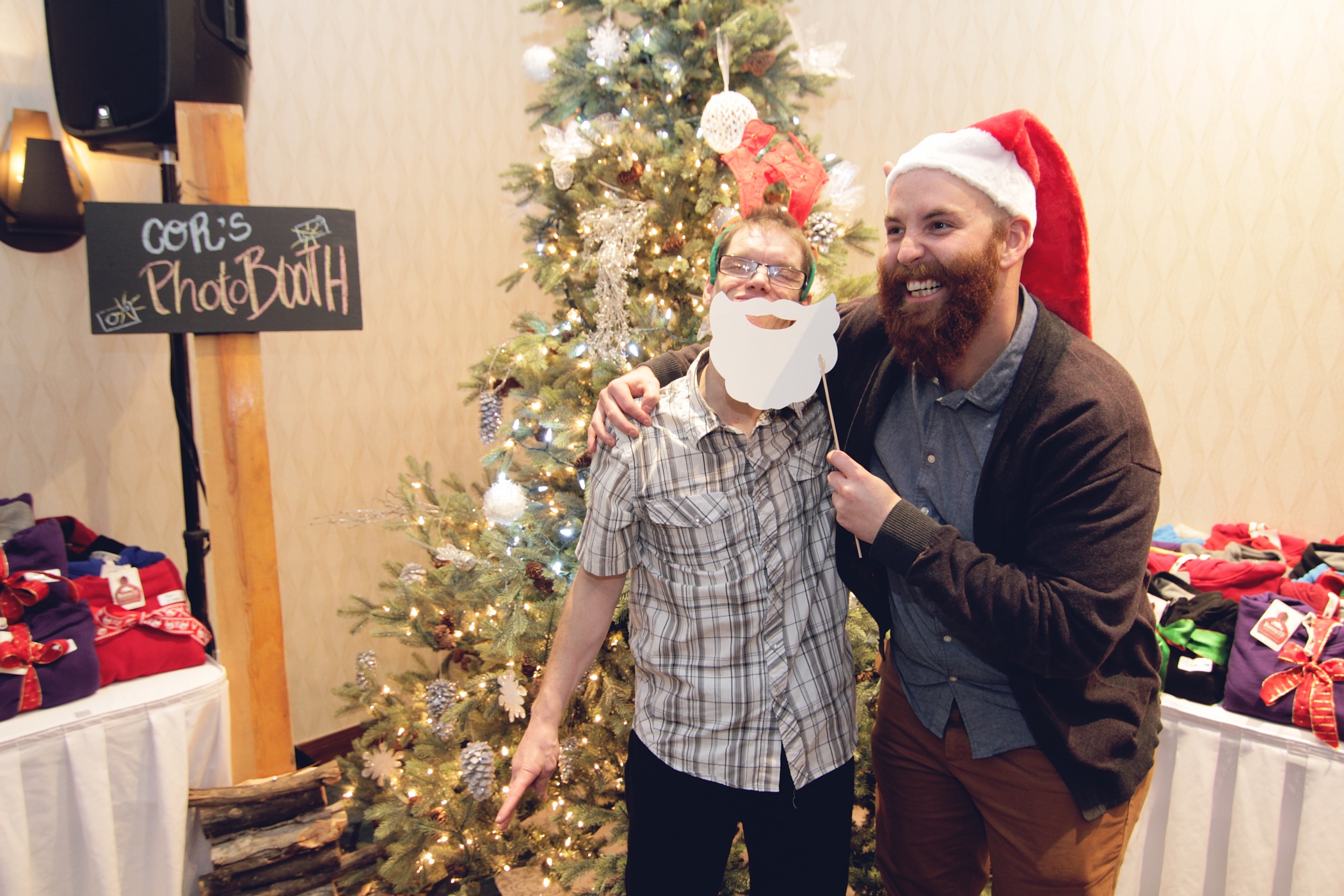
Holiday cheer was alive at the COR Christmas Dinner held at the Double Tree by Hilton Hotel in Regina on December 18th. COR families, friends, employees and individuals served gathered for an evening of festivities.  A scrumptious holiday feast, along with music by our favorite east coast band, Jakey’s Gin, and a rockin’ Photo Booth by the guys at Strategy Lab made the evening that much more spectacular! The smiles, joy and laughter shared by everyone made for such a memorable night! THANK YOU!

From the Board of Directors and Leadership Team  at COR, we wish you a very Merry Christmas and a Happy Holiday Season!

COR Christmas Dinner 2015

Angie and Richie Lookin’ Amazing!

COR Christmas Dinner 2015

We’re not quite sure which one’s more naughty? HeHe!

COR Christmas Dinner 2015

Ben and Larissa rockin’ the Santa gear!

COR Christmas Dinner 2015

We have an Elf, a Reindeer and Ms. Claus…. Happy Holidays!

COR Christmas Dinner 2015

Andrew and the ladies!

COR Christmas Dinner 2015

Who has the biggest beard? Jeph or Patrick?

COR Christmas Dinner 2015

And a HoHoHo to you! 🙂

COR Christmas Dinner 2015

What a beautiful group of people!!

COR Christmas Dinner 2015

The dance floor was on fire!

COR Christmas Dinner 2015

Two handsome fellas!

COR Christmas Dinner 2015

Elise, Dave, Roger and Lill spreading some Christmas Cheer!

COR Christmas Dinner 2015

HoHoHo! Sean (Mr. Coca Cola) and Jonathon!

COR Christmas Dinner 2015

Happy Holidays from the gals on Bronwyn and Gillian’s Support Team!

COR Christmas Dinner 2015

Dylan and Andrew making some holiday magic!

COR Christmas Dinner 2015

A beautiful photo of John and his mom, Voula.

COR Christmas Dinner 2015

Brother and Sister, Jarrod and Caleigh.

COR Christmas Dinner 2015

Stylin!

COR Christmas Dinner 2015

Couples Pic! Looking Great Lexi, Michaela, Andrew and Jordan!

COR Christmas Dinner 2015

Jesse and the ladies!

COR Christmas Dinner 2015

Lexi and Jordan.

COR Christmas Dinner 2015

Angie and her AWESOME Support Team!

COR Christmas Dinner 2015

Ho!Ho!Ho!

COR Christmas Dinner 2015

What a stylish group!


COR Christmas Dinner 2015

Naughty or Nice? hehe

COR Christmas Dinner 2015

Some Christmas Fright!

COR Christmas Dinner 2015

Jessie and Jesse!

COR Christmas Dinner 2015

Spreading the holiday cheer!

COR Christmas Dinner 2015

Lisa and Diandra spreading the cheer!

COR Christmas Dinner 2015

Brooklyn and her family!

COR Christmas Dinner 2015

John and his family.

COR Christmas Dinner 2015

Who’s that peeking over Santa?

COR Christmas Dinner 2015

Brenda and Marc spreading the holiday love!

COR Christmas Dinner 2015

Holiday Door Prize by: Jason Robin’s Artwork

COR Christmas Dinner 2015

Holiday Carvers, the Double Tree by Hilton Hotel Regina.

COR Christmas Dinner 2015

East Coast music by: Jakey’s Gin


Dispelling Myths About People with Disabilities

COR partnered with four AWESOME UofR Kin Students on a project for the International Day for Persons With Disabilities (IDPD 2015). Check out this great story about the project posted to the UofR webpage on December 2, 2015. Be sure to watch the video too!!

Article by: Costa Maragos

________________________________________

Some myths and misconceptions about people with disabilities are being explored in a compelling and thoughtful video produced by four Kinesiology students.

The video production is titled; Inclusion Matters: Debunking Common Myths Around Disability.

“We hope to generate some critical thinking and open-ended discussions about the current myths and stereotypes many people have about people with disabilities,” says Jordan Wirachowsky, one of four students involved in the production. “The overall message is we hope it can change  attitudes towards people with disabilities and create a more inclusive society.”

Wirachowsky, along with Matthew Pacholko, Jason Mo and Jordan Wyonzek, came up with the idea as part of a project in their Kinesiology 342 class, Developmental Disabilities & Well-Being, taught by professor Brenda Rossow-Kimball.

The video has been produced to coincide with International Day of Persons With Disabilities, December 3. That day, the video will be shown to a class at Campbell Collegiate in Regina.

In the video, students, faculty and staff on campus are asked to respond, sometimes with little or no warning, to various statements relating to myths about people with disabilities, including:

  • people with disabilities only like to spend time with others who have disabilities;
  • people with disabilities are more likely to be injured in the workplace;
  • people with disabilities are not independent and are unable to perform tasks of daily living.

“A few individuals gave some real thought to the questions and strived to dig deeper and find true meaning in the questions,” says Pacholko. “Some students appeared at a loss of explanation. Perhaps it was because they’ve never thought of the topic in such a way before or because they were put on the spot.”

Watch Inclusion Matters: Debunking Common Myths Around Disability, produced jointly by Brandon Wu of Strategy Lab and Creative Options Regina.

As part of the assignment, the students were asked to connect with a community organization and create a project that recognizes this year’s theme for International Day of Persons With Disabilities.

The students connected with Creative Options Regina, a non-profit organization in Regina that develops personalized support services for people with disability.

“Participating in class projects such as this helps raise awareness of our organization, while further contributing to the development of a more inclusive community for all,” says Michael Lavis, Executive Director of Creative Options Regina.

The video’s overall message, say the students, is the hope it can change peoples’ attitudes towards those with disabilities and create a more inclusive society.

“A more inclusive society helps build relationships and allows people with different abilities to be valued and shown dignity,” says Pacholko.


Click here for the full story on the UofR webpage.


The Al McGuire Award Winner for Transition to Employment 2015 – Patrick Flaman

Creative Options Regina (COR) is very happy to annouce that our very own Patrick Flaman is the winner of the Al McGuire Award for Transition to Employment 2015. His work ethic and attitude are like no one else, Patrick is an exemplary employee and just an all around great guy. We’re proud to have Patrick a part of the COR family.

Patrick Flaman-Al mcguire Award winner

“Freedom”: Patrick’s Story

I was living in an approved home before COR. I had a friend that lived in COR and I started hanging out with him more and more. I stayed for sleepovers and his friends got to know me a little bit. He wanted me to move to COR… I guess he suggested it to somebody!

All my stuff was in boxes and bags It felt good to load it in. It felt like freedom

We had some meetings and then Andrew and Jim showed up one day with a U-Haul truck. All my stuff was in boxes and bags. It felt good to load it in. It felt like freedom. I threw everything in there. I came to the house, unpacked the U-Haul and there were lots of people helping me out. I didn’t sleep that night. It was a new environment for me and it took me a while to fall asleep the first couple of nights. Once I felt more comfortable it started to feel like home. I had things given to me for my apartment. On my birthday I was given things that I basically wanted. It was sort of weird at first. I had birthday parties before, but I never got things that I needed. My friends all bought me a Keurig for Christmas this year!

I’m going to a class that helps me deal with my anger, my anxiety, stuff like that. Some days I don’t really feel the greatest… and some days it could be like… I don’t know its kind of an up & down thing for me. Some days are tougher than others. That’s why I’m going to a class. I know that people in COR aren’t judging me or anything and that they are there to listen not scold you. They are there to help, they don’t say “wow that’s a dumb question to ask”, they just listen and try to help. When I moved in I needed somebody to talk to and I had a friend who would sit and listen, help me out and talk with me. It made me feel more comfortable because I know there is always someone to talk to if I need to. I get to go places like the bar, camping trips, hanging out with my friends. There’s not really a curfew. Your friends treat you like an adult, and if there’s a problem we sort of talk it out and work through it.

My friends helped me find a job. I work at Sasktel right on 1st Avenue and Broad Street, not too far from the COR office. I do lots of different things. I sometimes work in the warehouse, I clean 2701’s and 3801’s, just different modems. I sometimes clean ONT’s. It feels good to have a job. I’m not isolating myself because now I actually have a job where I’m responsible for getting up and getting to work on time. I was sort of nervous when I started. I was nervous to ask questions on my first day, but when I got more comfortable I sort of came out of my shell. When I’m on my own I have a thing called Facetime. My friends Facebook, Facetime, text me to make sure I’m okay and stuff like that.

I really like hanging out with people from COR. Going to BBQ’s, hanging out, playing football, just hanging out. There’s one thing that I have learned from that. I don’t look at their disabilities, I look at them as a person. I go to the dances and I have a friend that has MS, but I don’t look at her as MS. I just look at her as just one of my friends I can hang out with and laugh, do stuff with.

What is cor to you?

[What is COR all about?]

People caring about other people, people who are willing to listen, talk to you and make sure you’re alright. They are basically there for caring. COR has a website with lots of videos. Everyone is welcome here and everyone is equal. You should check it out. COR is an awesome place to live.


– Patrick

The Business Case For Inclusive Employment

Inclusive Employment-Creative options regina

When: November 5, 2015 2-3pm

Where: Saskatchewan Science Centre Theatre

Cost: $25

RSVP: jeff@creativeoptionsregina.ca

Mark Wafer is the owner of six Tim Hortons franchises  in Ontario. Over the past 20 years, Mark and his wife Valerie have hired 118 people with disabilities and currently employ 46 people with disabilities from a work force of 250.

Mark believes there is a clear business case for inclusive employment. 

What is Community?

What is Community? from Creative Options Regina (COR) on Vimeo.

We need to rethink how we define “community”. People will say things like, “lets go out into the community”, when in fact we’re already IN community. We all make up the community; just being you makes you a part of it! Embrace what’s around you!

“Be A Superhero”

IN PRODUCTION–I’ve often wondered why are stories about superheroes so appealing? And why have they always been appealing throughout humankind’s history? (Recall the Roman and Greek gods and goddesses, and countless other myths of people with superhuman strength and power from all cultures throughout the world from all time.) If I was to give a less than educated guess as to their appeal, I would say that they touch something in us that we all long for…perhaps something missing from our very selves.

The reason I think this is because it seems too trite and easy to say that the appeal lies only in the fantastical. As if to say, just because those stories tell us of something that we do not see in real life they keep our attention. I can imagine a story with many fantastical details that would not make me rush to see the movie or buy the book. That is to say, fantastical does not always equal appealing.

So perhaps superheroes’ appeal lies in the fact that they are marked as special, set apart, different, but in a good way–a way that increases their human potential. I believe that is a better explanation of their universal appeal. I believe it appeals to us because we very rarely experience it ourselves.

If this lack is a common existential experience, what does that tell us about our ontological make-up? Why would we all universally experience the same lack or same desire? Were we meant for something greater? Did we, as a race, have a potential that we lost? Or do we intrinsically have it but lost our ability to see it clearly? Why the common yearning and desire?

And then, why do we feel a lack that we seemingly lack the ability to fill? Even recognizing that one desires to be “more” does not enable one to meet their own desire. Even the richest and most powerful people in the world often report that they feel this same lack in life, like something is still missing.

Perhaps finding out what really quenches that desire or fills that lack is the meaning of life.

What-are-you-fighting-for

1) Decide what you want to accomplish

Is there a specific task/dream that you want to accomplish for someone or with someone?

2) Pick a theme song

Don’t take yourself too seriously! Let loose and have fun

3) Decide what you stand for

What are you fighting for?


4to40 featured in Saskatchewan Chamber of Commerce Newsletter

Well 4to40 is at it again! This time it was the Saskatchewan Chamber of Commerce writing about the impact the program is having at the University.

University of Regina Supports students with disabilities 4to40 making a dent in Saskatchewan

To download the Saskatchewan Chamber Newsletter, click here –> Jan 2015 Edition

A culture of gentleness is also about being able to be vulnerable

“When I first heard about creating a culture of gentleness I had no idea what that meant.

After going to trainings, learning about gentle teaching, and seeing a culture of gentleness through the people around me in an organization that seemed so alien, I finally understood what it was. Talking about a culture of gentleness isn’t enough. You don’t really understand what it is until you start partaking in the movement of gentleness that has spread across Canada. It really is a powerful thing.

I learned that creating a culture of gentleness doesn’t just mean serving the people that we support, but serving every person you meet on the street and at home.

It is a way of life. I had to change my mind set and mold my thinking to something completely different and something unnatural to a lot of people. Growing up the way I did, I learned what it meant to love unconditionally and to care for people in a way that was personal. Maintaining a culture of gentleness is very personal. In order to have gentleness, I needed to care about another person more than myself and take their limitations and physical or mental state away from how I viewed them. I have come to do this everyday with the people I support. I see them more than just someone I look out for and someone I spend a lot of time with: I see them as friends and as a huge part of my life, because to them sometimes you are their family.

The way I create a culture of gentleness is finding a balance between being firm and being personal with each person I serve. The definition of gentle is to be kind and mild temperament; I have found that being that understanding person that will listen and care in a more personal way has created this culture of gentleness for our team. The more bonded we are on a personal level and the more we listen and show kindness to each other the more gentleness has spread.

In my team, I have had to hold team members accountable and have had to have some tough conversations, but at the same time, building each person  up and showing them that I care for them. In order to create a culture of gentleness, I needed to gain trust. In going out of my way to make team members feel comfortable with me, I demonstrated that I genuinely care for them and their life situations. I try and make the people that I serve feel appreciated and loved, I have written personal cards to each and every one of them praising them for things that I have seen them do well. To maintain a culture of gentleness, I have realized that taking the times is very important… A culture of gentleness is also about being able to be vulnerable with both the people that we support and those who we serve with. It has helped us grow individually, as well as grow as one.”

A-culture-of-gentleness-is-more-than...

Krystel, Team Leader

Why a Culture of Gentleness Makes Good Business Sense

The following article addresses the culture found in residential settings where the quality of life is shaped by the multiple relationships between residents and direct care support staff. I was struck by the correlation between the elements of a culture of gentleness and what LaLoux has described in “Reinventing Organizations” as new level of organization emerging that holds great promise. (see “Book Corner”) The organizing principle in this new tier is the constellation of the deep values individuals are liberated to express in their work. – Clint Galloway, Editor

Those of us in the business of providing care for others often find ourselves trying to balance sound financial decisions with decisions that directly impact the quality of care provided. Tipping the balance negatively on the economic side (we can refer to them as “scale tippers”) include staff turnover, worker’s compensation claims, unemployment claims and the cost of training new staff, all of which can lead to increased anxiety for those we support, lower staff morale, reduced quality of care and increased expenses. If we can agree that the scale tippers attribute to a majority of the increased costs then we can agree that by reducing the incidents of scale tipping we will be making decisions that can lead to expansion, fewer vacancies and other business opportunities. Fortunately, we are learning that the same things attributed to reducing expenses are also attributed to increasing the quality of care for the individuals we support.

The ever changing landscape of our system of care pales in comparison to the changes experienced by those receiving care due to staff turnover. I recently went to my dentist and was informed that I would have a different dental hygienist. “What…no Dena?” I thought, “she’s been my hygienist for many years and suddenly they expect me to have my teeth cleaned by someone else?” (Maybe if I’d flossed regularly I’d be less concerned). The care that the new hygienist provided for me and my teeth was more aggressive than I’m used to, leaving me wanting Dena back. After my initial disappointment, I’m okay now with the notion of waiting six months to find out who will do my cleaning next. But I would be much less settled if I was to experience this uncertainty with every shift change, 547 times over the next six months. This uncertainty about whom we will be interacting with in a face-to-face relationship makes us feel less safe and precipitates negative feelings and actions. It invades the entire culture of care. It is an expensive drain on our resources as well as the peace of mind of those that we support.

Providers report an average turnover rate of 49% among frontline direct caregivers. For agencies that experience high annual turnover rates (hopefully you’ve calculated your annual rate, if not this would be a good first step to take), it is likely staff will leave within the first six months of employment. This is the period in which the initial, comprehensive training will occur for new staff. At an average replacement cost of approximately $3,500 per employee, these costs weigh heavily on the economic scale.

Other scale tippers that often appear in a workplace with excessive rates of turnover include worker’s compensation, health insurance premiums and unemployment claims. Worker’s compensation claims tend to increase when the people in our care feel unsafe and are more likely to be aggressive towards staff, resulting in injury. Insurance rates increase when claims expense increases, and conversely, rates remain more stable when claims expense decrease; in some cases refund checks are cut to providers when there is a well-established “culture of gentleness.” When excessive scale tipping is present we are more likely to find frivolous worker’s compensation claims. This can reduce morale, as well as your bottom line, due to time spent resolving the issues. Another hidden cost of high turnover is health insurance premiums. Decreased turnover means that a large health insurance claim can be absorbed over time if staff continues to be employed after the claim has been paid. Unemployment claims, whether you are reimbursing or a contributing provider can be incredibly time consuming and expensive, costing up to $10,000 a claim in some cases.

Not to be forgotten in the discussion are wages and benefits. These are significant factors in finding and retaining qualified staff. According to the Michigan Assisted Living Association’s (MALA) 2009 Strategies for Improving Wages, Benefits, and Training to Staff Providing Community Mental Health Funded Residential Services, “Wages for direct care workers among the providers responding to this survey are as much as $3.25 per hour less than wages in other similar sectors of long-term care.” Although it will not bring parity to our Medicaid reimbursement rates, an established culture of gentleness will increase our ability to offer more attractive incentives for our employees.

Now that we’ve identified the scale tippers, how do we begin to tip them in more favorable directions? We cannot support the people we support without feeling supported by the people who support us.

That sentence will gain few points from English teachers, but it does offer insight into what our focus must be if we want to create a culture that is conducive for healthy bottom lines and healthy hearts alike.

Have you ever heard of “seagull management?” This philosophy is indicative of a culture that offers little or no proactive support, and when things are not going well—for example, if a group home is in chronic upheaval—management (the seagulls) intervenes by providing plenty of white droppings to go around. The flock then flies off, leaving those covered in white droppings to rectify the scale tippers. So where do we need to focus if we want to prevent the seagulls from disrupting our day at the beach?

Creating a culture of gentleness starts with the leaders of organizations recognizing that the way we train, support, and maintain our employees ultimately has a direct effect on both the quality of care provided and staff retention. Just as those we support in our system of care strive for unconditional valuing, uplifting interactions, and encouragement so do our employees. We all do. It is imperative that all levels of management have an understanding of the six elements (safe, valued, praise, demand, structure, and transitions) that lead to a culture of gentleness. The key to higher quality training includes finding quality trainers and materials. The Center for Positive Living Supports (the Center) has been involved with supporting staff in numerous Mobile Response Training Unit deployments. Overall, we find that without understanding, commitment, and congruent behavior from the host provider and CMH staff, we often find an increased amount of scale tipping.

For example, our home managers play a vital role. Staff often quit a direct care position, not because of the people they support in the home, but rather the way they feel devalued by management. Many home managers also feel devalued from lack of support from above. One way in which we demonstrate our appreciation of the value of employees is by providing tools that give them the confidence to help create a supportive culture under complex circumstances. These tools come in the form of training and gaining a basic understanding of what we can do. In a best case scenario, it is estimated that 2% of annual budgets are earmarked for training. To use this effectively we need to incorporate ongoing support within the day-to-day culture and focus less on the external classroom. This requires developing trainers and recognizing that mentors play a vital role in creating and sustaining a culture of gentleness.

When the going gets tough, the mentors get going. Not exactly the adage with which we are all familiar, but a culture of gentleness requires us to invest in some of the more skilled staff, enabling them to become mentors. They are able to assist in some of our more difficult situations that traditionally may have escalated into scale tipping events. If you can build a capacity of at least one mentor for every 50 staff you will be investing in someone who has the skill set to assist in our most complex situations. The goal of mentoring is to create a sustained environment that will begin to make everyone that lives and works in the setting feel safer, more valued and less volatile. MALA’s findings, from their aforementioned 2009 study, concluded, “Education related to this culture of “gentleness” should be broadened throughout the state.”

According to projections from Michigan’s Department of Labor and Economic Growth (DLEG), employment in the state’s long term care industry is projected to grow by 20 % over the decade from 2006-2016, adding nearly 25,000 new positions. May I take you back to the dentist chair experience for a moment? When it’s time to see your dental hygienist wouldn’t you rather have Dena, whom you have grown to trust and respect? Me too, and for the same reasons the people receiving our care and those we employ will look to you, and want to stay with you. We need entire organizations that embody the elements that constitute a culture of gentleness. Working within an organization built on trust, mutual respect and valuing, dedicated to quality service, is like a sunny day at the beach engaging in experiences that can be meaningful and fun without worrying about Seagulls hovering overhead. They have also learned the prerequisites for landing and being warmly welcomed on the beach.

Example: Ayanna is extremely bright, has a wonderful sense of humour, likes to shop, and cares deeply about her family. She has had over 15 different placements over the past several years and more recently spent two-thirds of a year in psychiatric hospitals. Ayanna spent 45 days at the Transition Home and her future caregivers attended the preliminary training offered by The Center. When Ayanna moved to her new home, our staff worked for approximately three weeks with her caregivers during which time the six elements were demonstrated, coached, and observed by the Mobile Response Team Mentor. Her current provider remains committed to supporting her in her home and for the past year she has lived successfully in her home having only been hospitalized for a week.

Ed Kiefer, B.S., L.B.S.W
The Center for Positive Living Supports, an affiliate of Macomb-Oakland Regional Center.